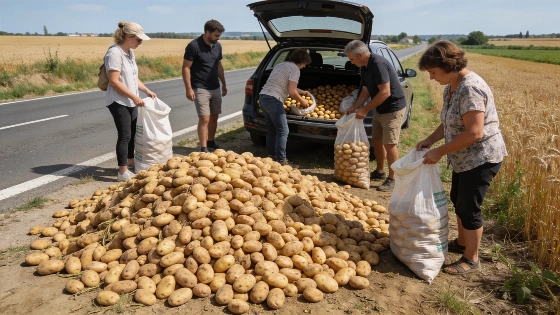
In July 2025, a French farmer in Gigny-Bussy opened his fields to the public, offering 500 tons of unsold potatoes for free. The gesture drew crowds—and led to some visitors reselling 20-kilo sacks for 15 euros, highlighting the challenges of agricultural surplus.
In the summer of 2025, a farmer in Gigny-Bussy, France, faced a dilemma familiar to many in agriculture: a warehouse packed with more than 500 tons of unsold potatoes and a new harvest fast approaching. With storage costs rising and no buyers in sight, he made a decisive move—he left the entire stockpile by a rural road, open for anyone to take, no payment or reservation required.
The offer, first reported by local media on July 31, 2025, quickly spread through social networks. Within days, the quiet road near the D396 was transformed as cars, trailers, and families from across the region arrived, eager to collect as many potatoes as they could carry. Some came to save on groceries, others out of curiosity, and a few with entrepreneurial motives.
From Generosity to Resale
According to the mayor of Gigny-Bussy, Pascale Chevallot, the potatoes were still fit for consumption, but keeping them in storage was no longer viable. The farmer’s decision to make them freely available was intended to prevent waste and clear space for the next crop. For several days, the field became a hub of activity, with people filling bags, boxes, and even car trunks with potatoes.
However, the open-access approach had an unintended consequence. Marion, a visitor from Landricourt, observed that some individuals returned multiple times, collecting large quantities. She reported that 20-kilo sacks were later being resold for 15 euros each—a move that turned a charitable gesture into a small-scale business opportunity for a few.
Who Took the Potatoes?
The scene was diverse. Families stocked up for the months ahead, while others, like Christophe, 68, stumbled upon the event by chance and filled their car. Dylan, from Saint-Dizier, admitted to collecting 600 kilos on a previous occasion, storing them in straw in his basement. The lack of limits or controls meant that the distribution was uneven, with some taking modest amounts and others far more.
Despite the scale of the giveaway, there were no reports of municipal intervention, health inspections, or penalties for reselling. The farmer himself remained anonymous, and the exact breakdown of how many potatoes ended up in homes versus being resold is unknown. The episode, as covered by Talent24h, illustrates both the generosity and the unpredictability of such open-access initiatives.
Surplus and Market Imbalance
The potato giveaway was not an isolated incident but part of a broader trend. Data from Agreste identified 2025 as a record year for French potato production, leading to a significant surplus. By August 2026, forecasts pointed to a 22% drop in production and a nearly 10% reduction in planted area, as farmers responded to the previous year’s imbalance between supply and demand.
Industry figures show that around 55% of French potatoes are absorbed by processing companies. In another case, a different farmer offered 50 tons of potatoes after a batch was rejected by McCain, charging a small entry fee but allowing visitors to take as much as they wanted. Meanwhile, Spanish producers have focused on securing buyers in advance, with networks planning to supply over 180,000 tons to Mercadona, underlining the importance of pre-arranged sales in avoiding waste.
The Gigny-Bussy episode highlights the volatility of agricultural markets and the challenges farmers face when supply outpaces demand. While the free potato mountain offered relief to some households, it also exposed the risks of uncontrolled distribution and the thin line between generosity and opportunism.