After a Sagalés coach crashed in Fogars de Montclús with at least 83 people aboard, Catalan interior minister Núria Parlon raised the possibility of changing rules on standing passengers. Bus operators say fewer permitted places could mean more frequent services.
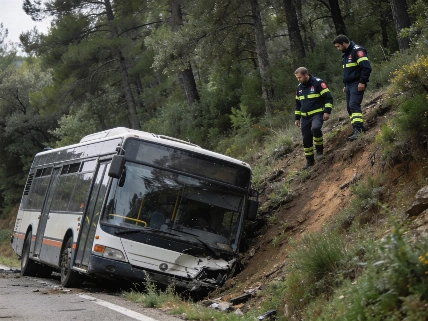
Eight passengers were reported in a serious condition after the Sagalés coach plunged down a 20-metre embankment in Fogars de Montclús, in the Montseny. The cause of the crash remained unknown, and the driver tested negative for alcohol and drugs. The bus was operating line 573 of the Bus Parc del Montseny service, which connects Sant Celoni railway station with Santa Fe del Montseny and stops at the park’s interpretation centre.
The accident renewed attention to a rule that allows standing passengers on some intercity bus models. Catalan interior minister Núria Parlon said on 26 October that the rules could be reviewed, particularly for routes on mountain roads. She also raised the possibility of applying a change to services linking the Maresme with Barcelona. In an interview with RAC1, Parlon said the Government should consider tightening the rules so passengers on intercity journeys do not have to travel standing. The Servei Català de Trànsit had been analysing the applicable structure.
At least 83 people were known to have been on the bus, based on those rescued and treated by emergency services. The Sistema d’Emergències Mèdiques treated 83 people after the crash. The response mobilised 23 ambulances and two medicalised helicopters, alongside three joint SEM-Bombers teams and three psychological-support teams. The exact permitted capacity of the crashed vehicle remains unclear: the model can carry around 60 seated passengers in its highest-capacity version, plus standing passengers, but confirming the exact figure would require the vehicle’s technical record or ITV inspection details.
Mossos d'Esquadra were investigating whether more passengers had been standing than the rules allowed. Mossos subinspector Quique Granero said some passengers could have been standing, but did not specify how many. Santi Lleonart, an inspector with Bombers de la Generalitat, described passengers boarding at intermediate stops on busy days after seats had filled. No passenger list is routinely kept for this type of service, so the precise number aboard was not immediately available. That uncertainty matters: the model’s maximum capacity alone cannot establish how many people were on this specific bus or whether it exceeded its authorised limit.
Under the reported rules, standing is permitted only in vehicles whose technical configuration supports it, including the seating layout and the required seat belts and handrails. The vehicle’s technical record sets out the approved number of seated places and any additional standing capacity; buses authorised to carry standing passengers face an 80 km/h maximum speed. The rules currently require passengers to sit and wear seat belts on coaches used for excursions or leisure tourism. Parlon’s comments opened a policy review, but no final ban, concrete measure or implementation date had been announced.
Bus operators’ association Fecav said it would comply with any change. It warned that reducing the number of places could require more seated capacity and more frequent buses to maintain the service.
The capacity question is separate from Madrid’s road infrastructure plans, including the proposed completion of the M-203 described in this earlier Madrid road report. In the Montseny case, crews were preparing to remove the wrecked bus with a heavy crane before reconstructing the crash scene. Three seriously injured passengers were being treated in intensive care at Hospital Germans Trias i Pujol. The other reported serious cases were at Hospital Josep Trueta, Hospital de Sant Pau and Hospital Vall d'Hebron, where two children were in paediatric intensive care.