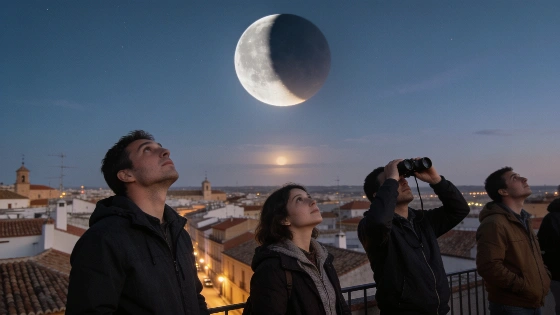
A partial lunar eclipse darkened the early morning sky across Spain and Europe. The event peaked at 6:12, with 93% of the Moon obscured. Iconic sites like the Coliseum and Córdoba’s Calahorra Tower framed the spectacle.
Spain and much of Europe witnessed a striking partial lunar eclipse in the early hours of Friday, as the Earth's shadow covered nearly the entire Moon. The phenomenon began at 4:34 and reached its maximum at 6:12, with the eclipse ending at 7:52 peninsular time. At its peak, about 93% of the lunar surface was hidden, creating a dramatic visual effect that was visible without any special equipment.
The eclipse unfolded in five distinct phases, starting with a subtle penumbral stage where the Earth's shadow gently blurred the Moon's edge. As the event progressed, a pronounced darkening appeared on the upper left of the lunar disk, marking the entry into the umbra. Unlike the total solar eclipse earlier this month, which required certified protective glasses, this lunar event was safe to observe with the naked eye.
Across Spain and Europe, the Moon was seen slipping behind famous landmarks. In Rome, it appeared nestled among the arches of the Coliseum, while in Slovakia, the lunar disk hovered near the walls of the Halic Castle. In Córdoba, the full Moon—known in August as the sturgeon moon—was photographed above the Torre de la Calahorra, adding to the collection of memorable images from the night.
Partial lunar eclipses differ from total ones in that only a portion of the Moon enters the Earth's darkest shadow, the umbra. This creates the characteristic 'bite' effect, with a large segment of the lunar surface shaded while a thin arc remains illuminated. During the maximum phase, only a faint sliver of light was visible on the upper right, as the rest of the Moon was enveloped in shadow. The final stages saw the Moon gradually regain its brightness as it emerged from the Earth's shadow.
Although the term 'blood moon' is reserved for total eclipses, the depth of this partial eclipse allowed for reddish and orange hues to appear on the shadowed portion. This effect is caused by the Earth's atmosphere filtering sunlight, scattering shorter blue wavelengths and letting longer red wavelengths reach the Moon's surface. Such phenomena continue to attract skywatchers and photographers, eager to capture rare celestial moments.
The eclipse followed closely after the total solar eclipse of August 12, which brought its own wave of excitement and required special viewing precautions. The contrast between the two events highlights the diversity of astronomical phenomena visible from Spain this summer. Notably, the lunar eclipse coincided with unusually cool August weather in parts of the country, as a polar air mass recently brought Madrid its coldest August day since 1998, according to recent reports.
Lunar eclipses occur when the Earth aligns directly between the Sun and the Moon, casting a shadow that can be seen from anywhere on the night side of the planet. The August sturgeon moon, named after the traditional fishing season in North America, added a unique context to this event. For many in Spain and across Europe, the spectacle offered a rare chance to observe the interplay of light and shadow on a nearly full Moon, framed by some of the continent’s most iconic architecture.