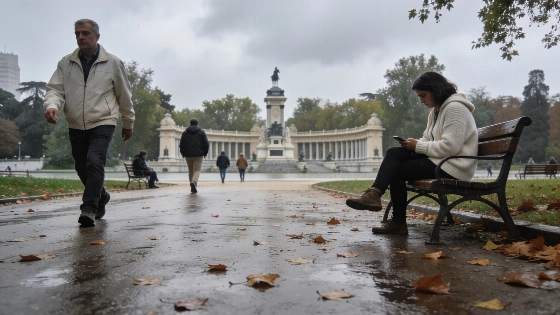
Madrid experienced its coldest August day in nearly three decades. A polar air mass pushed daytime highs down to 21.4°C, far below seasonal norms. Temperatures are set to rebound over the coming days.
Madrid faced an abrupt end to the meteorological summer this week as a mass of polar air swept across central Spain, sending daytime temperatures in the capital to their lowest August level since 1998. On Thursday, the historic El Retiro observatory registered a maximum of just 21.4°C, a figure that stands 8 to 10 degrees below the average for this time of year. According to the State Meteorological Agency (Aemet), this reading marks the coldest August day in Madrid in the 21st century, highlighting a rare break from the prolonged heat that has defined recent summers.
The data, while still pending final validation by the climatology department, is considered reliable. All surrounding weather stations reported similar values, reinforcing the exceptional nature of the event. Miguel Ángel Pelacho, Aemet’s delegate in Madrid, noted that although such temperatures are not unprecedented in the full historical record dating back to 1893, they are highly unusual in the context of the past two decades, when longer and hotter summers have become the norm.
Throughout the week, daytime highs in Madrid fluctuated between 21°C and 26°C, while nighttime lows dropped to 14°C or even lower in some areas, offering residents a rare respite from the typical August heat. The sudden chill was felt not only in the capital but also across much of Spain’s interior, as the polar air mass disrupted the usual late-summer weather pattern.
However, the cool spell is expected to be short-lived. Forecasts indicate a steady rise in temperatures from Thursday through Sunday, with highs in Madrid climbing by around 9 degrees. By Friday, the capital should see 26°C, reaching 30°C on Saturday and 32°C by Sunday. The return of anticyclonic conditions will bring more typical August weather, with clear skies and calm winds. Aemet does not anticipate issuing heat advisories in the immediate future, but warns that if the warming trend persists, alerts could be necessary by the end of next week. By Thursday, highs may reach 34°C.
Elsewhere in Spain, the end of August has brought a series of weather extremes. While Madrid contended with record cold, regions like Catalonia and the Balearic Islands recently faced severe storms and rare meteotsunamis, as detailed in reports on storm damage and emergency responses in Tarragona and Mallorca.
Looking ahead, September’s approach and the proximity of the equinox mean shorter daylight hours and a reduced likelihood of extreme heat, though isolated hot days remain possible. The recent cold snap serves as a reminder of the variability in Spain’s climate, even as long-term trends point toward warmer, longer summers. For now, Madrid residents can expect a return to more familiar late-summer conditions, with authorities closely monitoring for any further abrupt changes.
Spain’s climate has shown increasing volatility in recent years, with both record heatwaves and unexpected cold spells disrupting established patterns. The El Retiro observatory, with its climate series dating back over a century, provides crucial context for understanding these shifts. While this week’s cold is not without precedent, it stands out sharply against the backdrop of recent decades, underlining the importance of ongoing monitoring and adaptation to changing weather extremes.