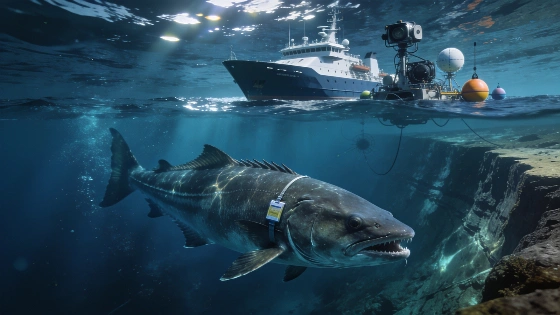
A Patagonian toothfish tagged by Argentine scientists in 2013 has been recaptured after 13 years, setting a new record for the country's monitoring program. The fish was found just 62 kilometers from its original release point, offering new insights into the species' behavior.
On June 6, 2026, Argentine researchers recorded a milestone in marine science: a Patagonian toothfish, also known as merluza negra (Dissostichus eleginoides), was recaptured in the southwest Atlantic, thirteen years after it was first tagged and released at a depth of over 1,000 meters off the coast of Buenos Aires.
The fish, originally marked by the Instituto Nacional de Investigación y Desarrollo Pesquero (INIDEP) during a 2013 scientific expedition, was found just 62 kilometers from its initial release site. This event marks the longest period a tagged specimen has remained at liberty within INIDEP’s ongoing monitoring program, which began in 2004.
Thirteen Years at Sea
The Patagonian toothfish is a deep-sea species known for its longevity—some individuals can live up to 50 years—and its commercial value. According to the FAO, the species is slow-growing and has low reproductive rates, making it particularly vulnerable to overfishing.
Since the start of the INIDEP program, 6,009 toothfish have been tagged and released, with 122 recaptures documented. Most recaptured fish have been found within 100 kilometers of their original tagging locations, though a few have traveled over 3,000 kilometers. The latest case stands out not for distance, but for the extraordinary duration between release and recapture, reinforcing the idea that many individuals remain loyal to specific areas along the continental slope.
Scientific and Commercial Implications
For marine scientists, the recapture provides rare, long-term data on the movement and survival of a species that is both ecologically and economically significant. The fact that the fish was found so close to its original release point after more than a decade suggests strong site fidelity, a behavior that can inform future management and conservation strategies.
The FAO has repeatedly warned that the Patagonian toothfish’s low fecundity and slow growth require careful monitoring and strict fishery controls. Long-term tagging data like this help researchers better understand population dynamics and the effectiveness of current regulations.
Industry Collaboration and the Role of Argenova
The recapture also highlights the collaboration between scientists and the fishing industry. The vessel involved, Argenova XIV, is operated by Argenova, the Argentine subsidiary of Grupo Nueva Pescanova, which is based in Galicia. After recent modernization, Argenova XIV is now the only active longliner in Argentina dedicated to this fishery, and it regularly hosts scientific observers and research activities in partnership with INIDEP.
According to Revista Puerto, a publication specializing in the fishing sector, the vessel’s involvement has been key to the success of the tagging and recapture program. The continued cooperation between industry and science is seen as essential for balancing commercial activity with the need to protect a vulnerable resource.
Looking Ahead
The exceptional longevity of this tagged Patagonian toothfish offers a unique reference point for understanding the species’ behavior in deep waters. As Argentina’s fisheries face increasing pressure, such data become crucial for ensuring that exploitation remains sustainable and that the species’ future is not put at risk.
Patagonian toothfish is highly prized on international markets, often sold as Chilean sea bass. Its management is closely watched by both national authorities and international bodies, given its ecological importance and the challenges of enforcing regulations in remote, deep-sea environments.