Catalan Clown Organizes Performances for Children in Conflict Zones. Catalan performer Pau Palaus has held a series of shows for children in refugee camps in Lebanon. His project helps restore a sense of humanity in places where it has been nearly lost. Plans include expanding the initiative throughout the Middle East.
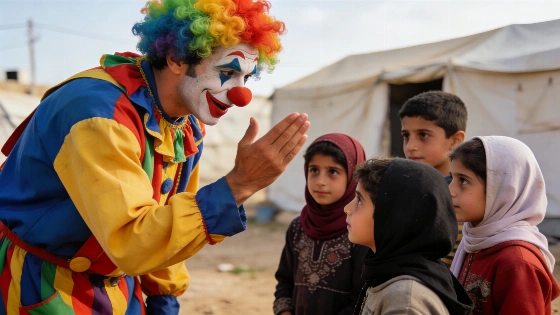
Catalan clown Pau Palaus, founder of the nonprofit organization Contaminando sonrisas, has completed a 12-day mission in Lebanon, where he performed daily in refugee camps, schools, and shelters for children who lost their parents due to war. His goal is to create a humanitarian 'clown corridor' to support children in conflict zones in the Middle East.
According to Palaus, laughter becomes a rare and valuable occurrence in situations of war and disaster. He notes that performing in such places requires special sensitivity: the audience is often wary at first, but gradually opens up, and even in the most closed communities, laughter helps to break down barriers. In Lebanon, the artist encountered conservative areas where women in burqas initially kept their distance, but after the performance, approached to express their gratitude.
Palaus emphasizes that his work is not just entertainment, but a way to remind people of their own humanity. He believes laughter works like a safety valve in a pressure cooker: it helps to release built-up tension, whether in a prison, refugee camp, or after a natural disaster. On one of his recent trips, people approached him after a show and admitted they had not felt joy in a long time.
Contaminando sonrisas operates not only in Lebanon: over the past year, the team performed in 17 countries, including China, Japan, Chile, Lithuania, the Netherlands, France, Portugal, and Italy. The main focus is participating in international street art and theater festivals, as well as humanitarian missions in regions where people are most in need of support.
In an interview, the artist said that his path to the profession began in childhood: he often entertained his classmates, although teachers did not always approve. His parents, despite knowing clowns, were initially worried about his future, so Palaus studied forestry and worked in the field for several years before fully dedicating himself to the stage.
An important part of his approach remains versatility: the performances are wordless to be understandable for children and adults regardless of language. The main tools are humanity, humility, and sensitivity. On humanitarian missions, the artist believes these qualities matter more than artistry.
Palaus pays special attention to working in places where life seems to stand still—such as prisons. He notes that preparing for such performances always brings inner tension, but once on stage, differences among the audience disappear: laughter brings together both guards and inmates. Such emotions are rarely found in closed institutions.
In Spain, the artist also performed after natural disasters, for example, in Paiporta after heavy rainfall. There, some in the audience initially watched the show with suspicion, but within a few minutes, their reaction changed: people shifted from laughter to tears, feeling relief. According to Palaus, it is precisely these moments that show how important laughter is for restoring inner balance.
The project is being carried out together with the artist's partner, and their six-year-old son often accompanies his parents on their trips. Palaus believes that this allows the child to experience the diversity of the world and avoid developing prejudices. However, they did not take their son to Lebanon due to the ongoing conflict.
In Spain, the topic of support through art is becoming increasingly relevant. Events related to culture and social support are also taking place in other regions of the country: for example, the authorities of Cadiz recently canceled the opening ceremony of an artist's star following a court decision, which sparked public outcry (more on the authorities' decision in Cadiz).
Context: According to RUSSPAIN, recent years have seen growing interest in Spain toward social initiatives aimed at supporting vulnerable groups through art and creativity. Such projects help not only children but also adults cope with the consequences of trauma and stress. International humanitarian missions involving artists from Spain have become a notable phenomenon, and Pau Palaus's experience shows that even in the most difficult conditions, art can restore hope and a sense of community.