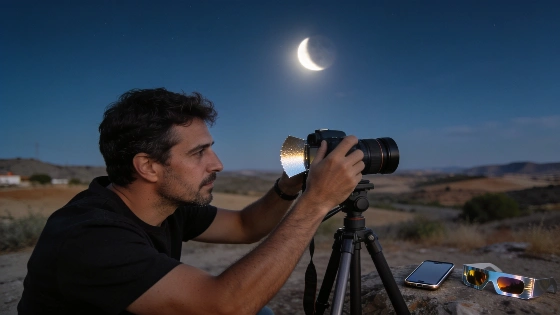
Néstor Rodan, with experience photographing three solar eclipses, reveals practical advice for capturing the August 12 event. His guidance covers mobile phones, semi-professional, and professional cameras, with a focus on safety.
On August 12, Spain will witness a total solar eclipse, an event not seen from the country in recent years. Photographer Néstor Rodan, who has previously documented three solar eclipses, is preparing to capture this rare phenomenon as the Moon completely covers the Sun. Rodan has outlined essential recommendations for anyone aiming to photograph the eclipse, regardless of whether they use a mobile phone, a semi-professional camera, or advanced photographic equipment.
Rodan emphasizes that preparation is crucial for achieving a clear and memorable image. He advises checking the exact timing and location of the eclipse in advance, as well as ensuring that all equipment is ready and functioning. For those using mobile phones, he suggests using a tripod to stabilize the device and adjusting exposure settings to avoid overexposure from the Sun’s brightness. Semi-professional and professional camera users are encouraged to use solar filters to protect both their eyes and their equipment, and to experiment with different focal lengths to capture the eclipse’s progression.
Safety remains a central concern in Rodan’s guidance. He warns that looking directly at the Sun, even during an eclipse, can cause permanent eye damage. He recommends using certified solar viewing glasses and ensuring that any camera or smartphone lens is fitted with an appropriate solar filter. These precautions are necessary not only for personal safety but also to prevent damage to photographic sensors.
Rodan’s experience highlights the importance of planning each shot, from choosing the right location with a clear view of the sky to anticipating changes in light as the eclipse unfolds. He also notes that capturing the atmosphere—such as the reactions of people around or the changing landscape—can add depth to the photographic record of the event.
Solar eclipses are rare and often draw significant public interest. The last total solar eclipse visible from Spain occurred decades ago, making this year’s event particularly notable for both amateur and professional photographers. According to astronomical data, the next opportunity for such a spectacle in Spain may not occur for many years. For those planning to document the eclipse, following expert advice like Rodan’s can help ensure both safety and the best possible photographic results.