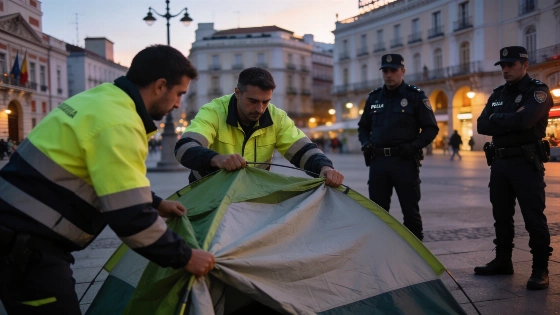
The encampment had stood in Madrid's Puerta del Sol for 37 days after a housing march on 26 September. Police began the clearance at 2.50am on Tuesday, 3 November, with municipal crews removing tents and tarpaulins under police escort. The Policía Nacional and Policía Municipal de Madrid took part in the operation.
Police sources reported two arrests for disobedience. Officials said the operation continued without serious disturbances. Municipal cleaning teams used machinery to dismantle the camp. National and municipal police units escorted them, while firefighters and Samur also took part. The Delegación del Gobierno said the intervention capped a gradual process that began when the camp was established.
The Delegación del Gobierno said in a statement that dismantling the site was a last resort. It cited alleged offences and incidents inside the camp and nearby, including cases affecting people staying there or passing by. Officers were also affected. The Delegation said the installations had remained despite its communications and that reported public-order disturbances and a specific risk to people and property had made clearance necessary. It said the operation was intended to protect people and property and restore the square’s ordinary public use. On 28 October, the government informed the camp’s legal advisory commission that it could be legitimate to end the gathering, saying its original protest purpose had been fulfilled and circumstances had changed. These were the institution's stated grounds for the operation.
The Delegation had sent two notices in the preceding days, saying the right to assembly had been respected for a sufficient period. After the second letter, around 600 people left the square. The organising commissions had announced the end of their activity on Saturday, following a farewell event the previous day. Members began leaving on Friday after receiving a notice urging them to withdraw on safety grounds, warning that the gathering would no longer receive the same legal protection. The government’s communication also cited the departure of the Sindicato de Inquilinas and the increasing presence of homeless people in the area as evidence that the circumstances had changed.
The camp began after a housing demonstration prompted by the eviction of Maricarmen Abascal, who had to leave her home aged 87 and died a few days later. The Sindicato de Inquilinas helped launch the encampment; the organising role later passed to commissions modelled on a horizontal structure in which everyone was meant to have a voice and vote. The union later withdrew from direct involvement amid internal disagreements about the camp’s direction. After leaving the square, it said it would take its housing demands to all neighbourhoods. A document from the commissions set out a plan to build a neighbourhood social movement and prepare a general strike.
The Delegation said it had remained in contact with the Sindicato de Inquilinas and later the commissions during the 37-day occupation. It said those exchanges had helped secure the protection of the Real Casa de Correos façade and the orderly removal of items covering Metro de Madrid ventilation shafts so cleaning work could be carried out.