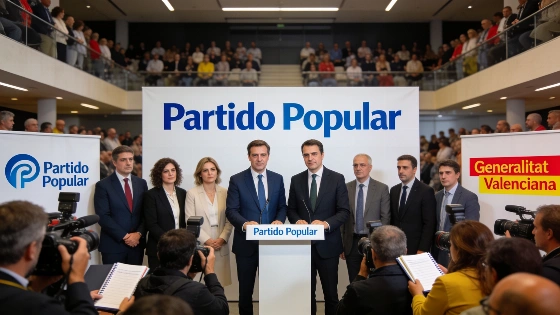
Miguel Tellado highlighted Juan Francisco Pérez Llorca’s achievements as Valencia’s president but stopped short of confirming his candidacy for 2027. The lack of a clear nominee is fueling tension within the regional PP.
At a high-profile event in Valencia, the leadership of the Partido Popular (PP) publicly commended Juan Francisco Pérez Llorca’s work as president of the Generalitat Valenciana but stopped short of confirming whether he will be the party’s candidate in the 2027 regional elections. The question took center stage at a Nueva Economía Forum breakfast, where Miguel Tellado, the PP’s secretary general, praised Pérez Llorca’s management while sidestepping questions about his political future.
Tellado acknowledged the challenging circumstances in which Pérez Llorca took office, citing the institutional crisis that followed Carlos Mazón’s resignation. He credited the current president with advancing reconstruction efforts and creating jobs, and noted that Pérez Llorca had managed to pass a budget in just a few months, a feat Tellado contrasted with the national government’s slower pace. Despite the praise, Tellado made no commitment about the party’s candidate for the next election cycle. Instead, he noted the “expectation” surrounding the issue and emphasized the PP’s central role in the region’s future.
The uncertainty was still evident on 22 October, when Juan Bravo, the PP’s deputy secretary for economic affairs, said in an interview with À Punt Ràdio that “everything points” toward Pérez Llorca becoming the candidate, but no official appointments had been made. Bravo said the party’s immediate priority was Spain’s general election, scheduled for 29 November 2026, and indicated that the regional nomination would be decided afterward. He also acknowledged that Pérez Llorca’s arrival after the previous leadership period could add to uncertainty within the Valencian branch.
Pérez Llorca defended his record, pointing to tax cuts and employment growth while also citing housing initiatives. He recalled that he accepted the presidency at the party’s request, without negotiating for personal gain, and said he would respect the party’s decision when it came time to select a candidate. On 22 October, he said he did not consider it the right moment to address his candidacy. He described himself as calm about the ongoing debate and said his approach to governance would not change regardless of speculation about his political future.
The absence of a definitive candidate is causing unease within the Valencian PP. National party leader Alberto Núñez Feijóo has visited the region twice in recent months but has not signaled support for any specific contender. Meanwhile, the regional party congress, which could clarify the nomination process, has yet to be scheduled, despite calls from former president Francisco Camps, who has expressed interest in running. Other potential candidates, including Valencia’s mayor María José Catalá and provincial leader Vicente Mompó, have publicly ruled themselves out, leaving Pérez Llorca as the only prominent name in circulation.
Reporting on the PP’s electoral timetable puts the Valencian regional election on 23 May 2027, about seven months after the party’s national campaign takes priority. The formal nomination is so being deferred until after the 29 November general election. The national leadership, including Feijóo and Tellado, continues to oversee the decision-making process; favorable public assessments of Pérez Llorca have not amounted to an official designation. Bravo said regional presidents were expected to continue, while stressing that none had yet been formally confirmed.
Under the party’s current timeline, candidates for provincial capitals will be announced on July 18, while decisions on regional presidential nominees, including for the Comunitat Valenciana, are expected after the summer. Tellado’s visible support at Thursday’s event is seen as a signal of confidence in Pérez Llorca, who stepped in after Mazón’s departure following criticism of his handling of the October 2024 dana (severe weather event). Bravo’s later timetable puts the regional nomination decision after the national election, leaving the expected candidacy politically indicated but not formally settled.
Valencia’s political field draws close attention because of the region’s size and influence within Spain. The Generalitat Valenciana oversees health and education, while also shaping regional economic policy. Leadership changes or uncertainty at the top can have impressive implications for public administration and investment decisions. The PP’s internal deliberations come as regional governments across Spain prepare for the next electoral cycle, with candidate selection often reflecting broader party strategies and alliances. The outcome in Valencia may set a precedent for other regions facing similar leadership questions ahead of the 2027 elections.