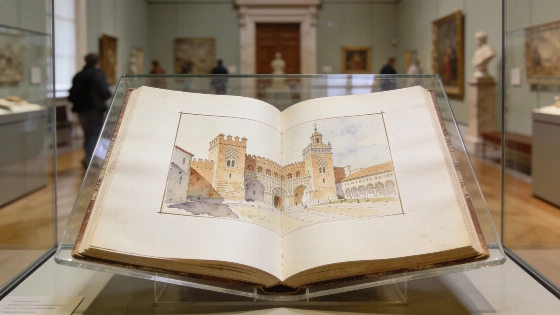
The Madrid exhibition runs through 17 January 2027. It brings together 37 works and personal records, most never shown publicly before.
Only two of the 37 works had been shown publicly before the Museo del Prado opened the exhibition on 13 October 2026. The display offers a rare look at an artist long overshadowed by his family’s fame.
The works span a career of nearly half a century. At the centre are 29 sketchbooks and albums dated from 1867 to 1917. They include family scenes and city views. Other pages record journeys through Spain and Italy; Morocco also features. A diary from 1894 is on view, alongside a letter to his father written from Toledo around 1875.
Madrazo was Federico’s youngest son. Raimundo was his brother, and Mariano Fortuny was his brother-in-law. His Madrid studio attracted Queen María Cristina. Archer Milton Huntington and Lázaro Galdiano visited, while Durand-Ruel was among his patrons. US President William Howard Taft commissioned El Parnaso. Madrazo also advised collector Pablo Bosch, a member of the Real Patronato of the Prado. He worked as a portraitist and copied old masters. He also drew for illustrated publications.
Curated by Pedro José Martínez Plaza, the exhibition is in Room 60 of the Villanueva building. It is part of the museum’s Almacén abierto programme, which since 2009 has brought little-known works from the Prado’s 19th-century collection into view. Some of that material is rarely displayed in the permanent galleries. Acquisitions made between 2006 and 2026 helped build the group of drawings and watercolours at the heart of the show. Sketchbooks complete the collection.
Travel fed directly into Madrazo’s work. His drawings and watercolours study Islamic architecture, including the Mihrab de la Mezquita de Córdoba and the Sala de los Abencerrajes. Other sheets track changing light in the landscape. Toledo appears in his work, as does Venice. Sketchbooks include views of Fez and Tangier, reflecting an interest in Eastern culture that also shaped his illustrations for publications. The Prado’s records show that he experimented with photography, too.
His notebooks also document Fortuny’s stays in Granada and Portici in the early 1870s. Studies relate to Vendedor de tapices and La vicaría. Detalle del interior del estudio de Mariano Fortuny en Roma captures objects in Fortuny’s studio before its contents were sold after his death.
At the Prado, Madrazo copied El Greco. He studied Velázquez and Goya there as well, using their paintings to examine line and colour. Light mattered, too. A small watercolour copy of El Greco’s late-16th-century Retrato de caballero anciano is on view. It measures 13 by 12 centimetres. Another central work is Madrazo’s mature interpretation of Velázquez’s El bufón llamado don Juan de Austria. Four partial copies of Tiépolo’s ceiling decorations for the Salón del Trono at the Palacio Real reveal his attention to complex compositions and tonal variation.
The show includes portraits and informal studies. Some record family life and household objects; others focus on animals, exercises in observation rather than commissions. The Prado owns seven paintings by Madrazo. Its collection also includes 29 albums and more than 50 drawings and watercolours. Only one painting, his self-portrait, is in the exhibition. Madrazo helped preserve the family archive, part of which the Prado acquired in 2012. His 29 sketchbooks form the museum’s second-largest such collection, after Martín Rico’s 40. The earliest self-portrait on display dates to 1880.
Ricardo de Madrazo, 1852 to 1917: dibujos y acuarelas is open in Room 60 of the Villanueva building at the Museo Nacional del Prado, Paseo del Prado, s/n, Madrid, through 17 January 2027.