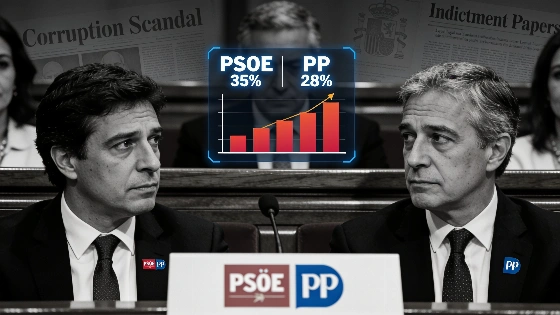
PSOE has increased its lead over PP, reaching 33% in voting intention. The latest CIS barometer shows a 7.9-point gap, even after high-profile corruption cases. Vox and Sumar also see declines.
Spain's political landscape has shifted again, with the PSOE strengthening its position despite recent corruption scandals involving prominent figures. According to the July barometer from the CIS, the PSOE now stands at 33% in voting intention, marking a 1.7-point increase from June. This recovery follows a sharp drop last month, which was linked to the indictment of former president José Luis Rodríguez Zapatero and the unsealing of the 'caso Leire Díez' investigation.
The Partido Popular (PP) has seen its support fall by two points, now polling at 25.1%. This places the PSOE 7.9 points ahead, a significant margin in the context of ongoing political turbulence. Vox also lost ground, dropping half a point to 15.3%. Meanwhile, Sumar and Podemos both slipped by three tenths, registering 6.1% and 2.5% respectively. The survey, based on over 4,000 interviews, was conducted in early July, just before the public learned of the conviction of David Sánchez, brother of the Prime Minister, for malfeasance.
The timing of the poll is notable, as it captures the immediate aftermath of the PP and Vox agreement in Andalusia, which secured Juan Manuel Moreno's investiture. The period also saw heated debate over the 'ley de nietos', a provision in the Law of Democratic Memory that facilitates Spanish nationality for descendants of exiles from the Franco era. PP leader Alberto Núñez Feijóo accused the government of 'engineering new voters', while Vox called for the suspension of postal voting rights for expatriates.
These developments have added to the volatility within Spain's left-wing bloc. Sumar, in particular, has struggled to regain momentum, remaining below 7% in voting intention since March, according to the CIS. The ongoing crisis within Sumar coincides with broader challenges for the left, as both Sumar and Podemos continue to lose support. The July barometer may also reflect the impact of recent government deals and legal controversies, which have shaped public perception in the run-up to potential elections.
Internal tensions within the PP have also surfaced in recent months, especially regarding the party's stance on citizenship laws and absentee voting. For further context on these disputes and their effect on the party's strategy, see this analysis of recent criticism faced by Alberto Núñez Feijóo within the PP. These dynamics underscore the complex environment in which Spain's main parties are operating, with shifting alliances and public scrutiny influencing their prospects.
The CIS (Centro de Investigaciones Sociológicas) is Spain's leading public opinion research institute, regularly publishing barometers that track political sentiment. Its findings are closely watched by parties and analysts, as they often signal emerging trends ahead of national elections. The current data suggest that, despite ongoing scandals and legal proceedings, the PSOE has managed to consolidate its base, while the PP and its allies face renewed challenges in regaining voter confidence.