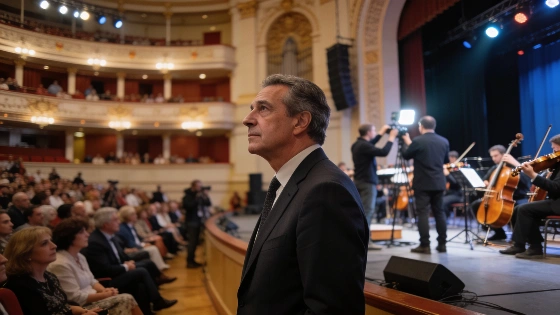
Ramón Espinar left a mark on Madrid through major cultural festivals and fiscal reforms. His work reshaped the region’s institutions and set new standards for public service. Espinar’s influence is still visible in Madrid’s cultural and economic life.
Madrid’s rise as a modern cultural and economic center owes much to Ramón Espinar, who died on September 3. Espinar played a central role in this transformation, launching the Festival de Otoño and the Otoños Culturales. These events brought international directors and performers to Madrid and its towns, raising the city’s cultural profile and drawing comparisons to Paris.
Espinar’s work went beyond the arts. As head of the Consejería de Hacienda, he reformed tax regulations to make them fairer and more progressive, while also supporting business and industrial growth. These changes helped Madrid become a leading industrial region, with applied science and innovation driving economic progress.
In 1986, Madrid hosted its first major international contemporary art fair, ARCO, which quickly became one of the most important art events in Europe.
Espinar’s approach to government was shaped by his commitment to social democracy and parliamentary principles. He started his career in Leganés, where he was elected mayor after earning his law degree. In 1979, he became president of the Asamblea de Madrid, where he defended the rule of law and representative democracy, drawing on the ideas of Gregorio Peces-Barba Martínez.
He worked to bring cultural events and exhibitions to smaller towns, not just the capital, making sure that investment in the arts reached beyond the city center. The creation of the ORCAM orchestra in 1987, now led by Alondra de la Parra, reflects his focus on building lasting institutions. Major exhibitions of artists like Antonio Saura, Antoni Tàpies, Eduardo Chillida, and Anselm Kiefer further established Madrid as a center for the arts.
His fiscal reforms were just as important. By updating tax codes and encouraging industrialization, Espinar helped make Madrid a place where business and innovation could grow. He often spoke about the value of applied science for knowledge transfer and social progress, a view that shaped Madrid’s modernization in the late twentieth century.
According to Spain’s Ministry of Culture, the late 1980s saw Madrid’s cultural sector grow by over 30%, with new institutions and festivals attracting international attention and investment. This period is widely credited with establishing Madrid as a leading European cultural capital.
Espinar’s influence continued after he left official roles. He advised later governments of all political backgrounds, always putting the interests of Madrid’s citizens first. His willingness to work across party lines set a standard for public service that is still rare in Spanish politics.
While party disputes and leadership battles often make headlines in Madrid, as seen in recent coverage, Espinar’s legacy is defined by institution-building and practical results. His career shows that lasting change comes from concrete action—launching festivals, reforming tax law, or supporting scientific innovation. In a political climate often focused on short-term gains, Espinar’s example of steady, principled leadership continues to shape Madrid’s path.