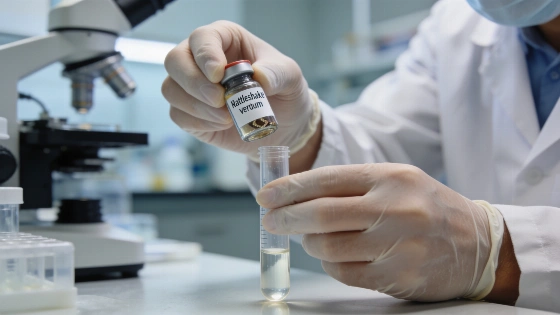
Scientists in the US have developed an experimental antivenom using three proteins found in the blood of the western diamondback rattlesnake. The formula proved nearly ten times more potent than current commercial options in laboratory mice, but human trials remain a distant prospect.
Researchers at the University of Maryland and Texas A&M University-Kingsville have identified a new approach to neutralizing rattlesnake venom, using a combination of three naturally occurring blood proteins from the western diamondback rattlesnake (Crotalus atrox). In controlled experiments, this protein mix protected mice from lethal doses of venom with far less material than required by standard commercial antivenoms.
The study, published in April on bioRxiv, remains at an early stage and has not yet been tested in humans. The team focused on three FETUA proteins—FETUA-2, FETUA-3, and FETUA-5—each targeting different toxic components of the venom. When used individually, none of the proteins offered full protection. However, their combination blocked multiple toxic effects, including tissue damage and hemorrhage, resulting in a median effective dose (ED50) of just 5.6 mg/kg. For comparison, the widely used CroFab antivenom required 52.6 mg/kg to achieve similar results in mice.
How the Protein Mix Works
The FETUA proteins act by binding to and neutralizing various venom enzymes, particularly metaloproteinases responsible for tissue destruction and bleeding. Previous research had already highlighted the role of FETUA-3 in targeting a broad range of these enzymes. The new study demonstrates that combining all three proteins covers a wider spectrum of venom activity, preventing death in laboratory animals exposed to high doses.
Importantly, the researchers mixed the venom and proteins before administering them to the mice, simulating immediate neutralization rather than real-world treatment after a bite. Each group of five mice received a venom dose three times higher than the median lethal amount, and their survival was monitored over 48 hours. While the results are striking, they do not guarantee similar effectiveness in humans or in clinical scenarios where treatment is delayed.
Potency Compared to Existing Antivenoms
In direct comparisons, the experimental FETUA mix was nearly ten times more potent than CroFab, the leading commercial antivenom, and about three times more effective than the complete serum from Crotalus atrox itself. However, the authors caution that these figures reflect laboratory conditions and should not be interpreted as a direct prediction of clinical outcomes.
The study also tested the formula against venoms from other snake species. The FETUA mix provided significant protection against some, such as Crotalus adamanteus and Echis carinatus sochureki, but failed to prevent death from Bitis arietans venom. This suggests that while the approach has potential, it is not universally effective and may need to be tailored for different snake species.
Challenges Before Human Use
Despite the promising results, several hurdles remain before such a protein-based antivenom could be used in people. Snake venoms are complex, often containing 50 to 100 different toxic proteins from various families. The current formula targets only metaloproteinases, leaving other dangerous components like neurotoxins and phospholipases unaddressed. A truly broad-spectrum antivenom would likely require a cocktail of molecules with diverse mechanisms.
Further research is needed to test the formula when administered after envenomation, as well as to assess its safety, distribution in the body, immune reactions, dosing, and feasibility of large-scale production. The World Health Organization estimates that snakebites cause up to 5.4 million injuries, over 80,000 deaths, and hundreds of thousands of permanent disabilities each year worldwide, underscoring the urgent need for better treatments.
Efforts to harness natural resistance mechanisms are not unique to this study. Similar strategies have been explored in other fields, such as the restoration of ecosystems by removing invasive species, as seen in the return of clear waters to Pyrenean lakes after fish eradication. Both cases highlight the potential of learning from nature to solve complex biological challenges.