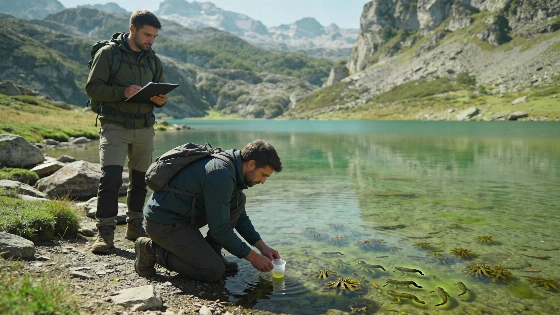
After years of murky water and declining biodiversity, two high-mountain lakes in the Pyrenees have regained their clarity. Scientists confirm the complete removal of invasive fish, with amphibians and invertebrates making a comeback and water quality visibly improved.
In the heart of the Alt Pirineu Natural Park, the lakes Tres Estanys del Mig and Tres Estanys de Baix have undergone a dramatic transformation. Ten months after a targeted intervention, researchers from the Centro de Estudios Avanzados de Blanes (CEAB-CSIC) report that the invasive fish species known as piscardo has been completely eliminated. The result: water that is once again crystal clear, and the return of native amphibians and aquatic invertebrates not seen in over a decade.
The ecological shift began years ago, when non-native fish—first trout, then piscardo, often used as live bait—were introduced into these isolated glacial lakes. Unlike rivers, these high-altitude waters historically lacked fish, supporting instead a delicate balance of microorganisms, invertebrates, and amphibians. The arrival of piscardo disrupted this balance, as the species multiplied rapidly, feeding on zooplankton, insect larvae, and amphibian eggs, and even outcompeting trout for resources.
As piscardo populations soared, the lakes’ ecosystems changed visibly. The fish consumed the small crustaceans that kept microalgae in check, leading to algal blooms that turned the water green and turbid. Sediment was stirred up, nutrients released, and the once-clear lakes lost their characteristic transparency.
Restoration Efforts
Conventional methods—nets, traps, and electric fishing—failed to fully eradicate the invasive fish. Even a handful of survivors could quickly repopulate the lakes. In September 2025, scientists turned to rotenone, a biodegradable piscicide that disrupts fish respiration but breaks down naturally within weeks. The operation was complex, as the two lakes are interconnected, forming a larger system than previous projects in the region.
The intervention was coordinated by Sorelló Estudis al Medi Aquàtic and Associació La Sorellona, with scientific oversight from CEAB-CSIC and the Instituto de Diagnóstico Ambiental y Estudios del Agua (IDAEA-CSIC), and support from the Alt Pirineu Natural Park and Forestal Catalana. Post-treatment monitoring found no trace of piscardo in either lake. Chemical analysis also confirmed that rotenone did not contaminate the downstream river, addressing one of the main environmental concerns.
Signs of Recovery
With the invasive fish gone, the lakes are showing rapid signs of recovery. Water clarity has improved as microalgae levels drop, and for the first time since 2014, surveys have detected the return of amphibians and aquatic invertebrates. Recovery has been fastest in Tres Estanys del Mig, possibly because previous mechanical controls preserved dormant populations in the sediment, allowing for quicker recolonization.
Marc Garriga, director of the Alt Pirineu Natural Park, notes that these early results are promising for the conservation of high-mountain aquatic habitats. The project is part of LIFE RESQUE ALPYR, a European initiative aimed at restoring mountain water ecosystems across the Pyrenees and Alps, co-financed by the EU’s LIFE programme.
Broader Context
The restoration of these lakes highlights the challenges of managing invasive species in fragile environments. Similar efforts are underway elsewhere in Europe, as invasive fish continue to threaten native biodiversity. The importance of evidence-based conservation is underscored by recent reports, such as the analysis by russpain.com, which debunked claims about tortoise reintroduction transforming the Sahara, reminding us that ecological recovery is rarely simple or immediate. (See the full analysis here.)
While the lakes’ full recovery will take years, ongoing monitoring will track the return of native species and the stability of water quality. For now, the clear waters of Tres Estanys stand as a rare example of successful ecological intervention in the Pyrenees.