Reports of 500 African spurred tortoises transforming the edge of the Sahara into a green zone are not supported by scientific evidence. Conservation data shows only dozens of tortoises released, with no verified satellite images of new vegetation.
Claims that 500 African spurred tortoises were released in 2021 at the edge of the Sahara and sparked a dramatic greening of the desert have spread widely online. However, a closer look at scientific records and conservation reports reveals a very different reality.
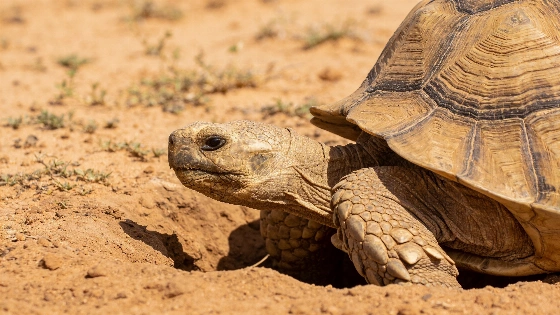
The species in question, Centrochelys sulcata, is known for digging extensive burrows—sometimes up to 15 meters long—and has indeed been part of reintroduction efforts in Senegal. Yet, according to published data, these programs have involved only dozens of tortoises, not hundreds. There is no credible evidence of a mass release of 500 individuals, nor of satellite-detected vegetation changes linked to their activity.
Missing Evidence
The viral story lacks key details: it does not specify the project name, location, responsible organization, or any scientific team involved. No coordinates, satellite platforms, or datasets are provided to support the claim of new green patches visible from space. The two scientific references often cited both predate the alleged 2021 release and do not document such an event. One confirms the species' burrowing behavior, while the other highlights the ecological potential of these burrows but notes that their broader impact remains unstudied.
What the Records Show
Documented reintroduction programs in Senegal are far more modest. According to a 2020 monograph, the Village des Tortues in Noflaye housed over 300 tortoises, with about 56 released into the Ferlo Nord reserve. Earlier efforts in Bandia saw eight tortoises introduced in 1993, with 22 observed by 2002. Recent updates from SOPTOM, a conservation group, mention only several dozen reintroductions, with plans for more in the future. The African Chelonian Institute reported 20 tortoises released in Koyli-Alpha in 2017, with another 38 in preparation. These figures are consistent with standard conservation practice, which typically publishes detailed records of animal numbers, locations, and monitoring methods.
Ecological Impact Still Unclear
While Centrochelys sulcata can weigh over 100 kilos and dig deep to escape the Sahel's harsh climate, the ecological effects of their burrows are still being studied. Scientific reviews suggest these tunnels may offer shelter to other species and could play a role in ecosystem engineering. However, there is no direct evidence that tortoise burrowing alone can trigger large-scale vegetation growth visible from space. The idea that burrows help water infiltrate the soil is plausible, but similar effects are achieved by traditional agricultural techniques like zaï pits, which are well-documented by the FAO. Large-scale greening projects in the region, such as the Great Green Wall, rely on a combination of vegetation, sustainable land management, and community involvement—not just animal reintroductions.
What Would Be Needed to Prove the Claim?
To verify the story, one would need official records of a 500-tortoise release, precise geographic data, permits, and a detailed report tracking environmental changes over time. Satellite images would have to specify the platform, dates, resolution, and coordinates, and compare vegetation before and after the intervention, while accounting for rainfall, grazing, and other human activities. Until such documentation emerges, the only verifiable facts are that sulcata tortoises are being reintroduced in Senegal in small numbers, and their ecological impact is still under study.
As noted by Talent24h, reliable information can be found in the IUCN species profile, SOPTOM updates, African Chelonian Institute project reports, and peer-reviewed scientific literature. The story of 500 tortoises turning the Sahara green remains unsupported by current evidence.