How EL PAÍS Correspondents in Valencia Changed Regional Journalism. Fifty years ago, EL PAÍS correspondents in Valencia witnessed political transformations. Their work set the standards for independent regional journalism. We recall the key moments and challenges of that era.
Fifty years ago, when the first issue of EL PAÍS was published, correspondents in Valencia found themselves at the heart of political change. As the Francoist regime was coming to an end, it was regional journalists who became the key channel for conveying information about emerging democratic movements. Even in the newspaper’s debut edition, the focus was on anti-Francoist policies and preparations for the upcoming elections, which were scheduled for the spring of 1977.
During those years in Valencia, three political platforms were actively taking shape: the representatives of the popular fronts, Christian Democrats, and leftist parties. Notable figures included Emilio Attard, who aimed to draw on the legacy of Luis Lucia and Gil Robles, as well as Vicente Ruiz Monrabal, who advocated a centrist position. On the left, Manuel Broseta and Josep Lluís Albiñana sought new alliances and leaders to unite efforts between the Junta Democrática and Consell Democràtic.
First steps and challenges
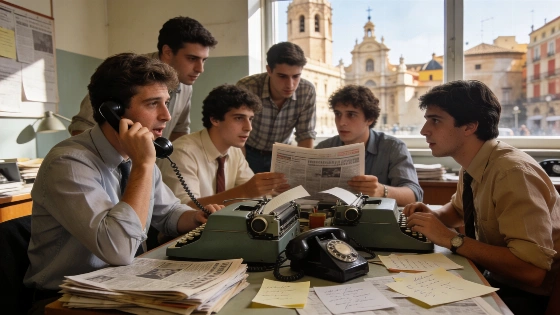
The work of correspondents in Valencia in the 1970s involved a constant search for new formats and platforms. Many started out on their own, without the backing of major newsrooms, renting small offices in the city center and sharing space with colleagues from other publications such as _Avui_ and _Marginados_. Later, representatives from _Mundo Obrero_ and designers working with ecological and nationalist publications joined them. They were all young journalists just beginning to build their careers outside the traditional local press.
With the development of the constitutional process in Spain and the emergence of new autonomous communities, the demand for regional information rose sharply. Valencia-related topics became an important part of the national agenda, and correspondents from the provinces gradually gained the status of key players in shaping public opinion. As noted by EL PAÍS, it was during this period that central media outlets began to realize that it was impossible to build a democratic Spain without taking regional interests into account.
Technology and correspondents’ daily routines
News transmission in those years was far from today's standards. Correspondents dictated material by phone to editorial staff who typed up texts for publication. In the event of vacations or business trips, replacements had to be appointed in advance — for example, Bel Carrasco and Miguel Ángel Villena later took on important roles in the Madrid and Barcelona newsrooms. All new hires were required to follow _El libro de estilo_, which set the standards for EL PAÍS journalism.
Major events, such as the Los Alfaques campsite tragedy in Tarragona in the summer of 1978, demanded the rapid mobilization of correspondents from different regions. At that time, the death toll reached 215, and journalists, including those from Valencia, worked at the scene under difficult conditions. To travel across the region, they used personal cars bought in installments with their first fees.
The growth of the regional newsroom
In the early 1980s, EL PAÍS correspondents in Valencia received their own office on Moratín Street, and in 1986 the first regional editorial office was launched, accompanied by a daily four-page supplement. The opening was attended by the publication’s leaders, including Jesús Polanco and José Ortega Spottorno, who emphasized the importance of independent and critical regional journalism.
One of the most significant events for the correspondents was the tragedy at the Tous dam in October 1982. A breach in the dam on the Júcar river basin led to large-scale destruction and resulted in the highest pay for articles in all the years of work. While covering this incident, EL PAÍS journalists not only quickly reported the news but also met with the victims in person, as was the case with businessman Luis Suñer, who lost all his documents and did not know how much money was left to restore his business.
Continuity and new challenges
Over the years, many correspondents from the regions have taken leadership positions in the central editorial office. Their experience and professional standards laid the foundation for new generations of journalists. Recalling the early years, participants note that it was collective unity and editorial support that enabled them to withstand attempts at pressure and maintain the publication’s independence.
The importance of regional journalism and its impact on the national agenda has also been demonstrated by other events in recent years. For example, a disruption at the Carpetana metro station in Madrid caused train service to be halted for five hours, sparking discussion not only in the capital but also in other regions of the country — you can read more about this in the article on the consequences of the incident on Line 6.