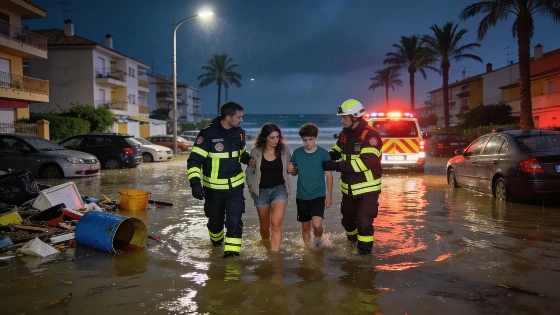
Severe overnight storms in Costa Daurada caused record flooding, injured 11 people and forced evacuations from a campsite and nightclub. Key roads and train lines were closed as emergency services responded.
Overnight torrential rains battered several towns along the Costa Daurada, unleashing record-breaking floods that left 11 people injured and forced hundreds to evacuate. The heaviest impact was felt in Torredembarra, El Vendrell, Roda de Berà, Creixell and Altafulla, where rainfall exceeded all previous records since measurements began. Emergency services worked through the night as streets turned into rivers, vehicles and containers were swept away, and key infrastructure was severely affected.
Authorities reported that the train station at Sant Vicens de Calders was completely flooded, while the N-340 highway was closed for hours due to impassable conditions. In Roda de Berà, a local observer recorded an extraordinary 276 litres per square metre on the coast, far surpassing official figures elsewhere. The mayor, Pere Virgili, described the event as unprecedented in his lifetime, highlighting how the railway embankments acted as barriers, worsening the flooding in some areas.
One of the most serious incidents occurred when a wall collapsed in Roda de Berà, critically injuring a minor who was taken to Joan XXIII Hospital in Tarragona. Another wall fell near the port, injuring three members of a family who had been resting after working at a night market. In the Arc de Berà campsite, the force of the water broke through the perimeter wall, sending vehicles and containers into evacuation tunnels and forcing firefighters to relocate 300 campers to a sports hall in the middle of the night. Many were woken by neighbours or staff and had to leave with only what they were wearing, as water reached waist height.
Tourists in Coma-ruga expressed frustration at the lack of warning, with some left to bail water from their cars the next day. Long-time residents noted that flooding reached levels never seen before, and some pointed to the area’s history as a wetland and the growing impact of climate change. The flooding also damaged beaches and left a hotel and an underpass completely submerged, with vehicles trapped inside. Around 150 young people were evacuated from the Macarella nightclub as a precaution.
Regional authorities explained that the Es-Alert emergency system was not activated because the meteorological risk level had not reached the required threshold. Between 3 and 6 a.m., emergency number 112 received 600 calls, and firefighters carried out 300 rescue and evacuation operations. The regional interior minister, Ramon Espadaler, acknowledged that the rainfall far exceeded forecasts and assured that the government would support affected municipalities. He also clarified that alerts are only sent when the risk level is at the highest categories, and that emergency services responded quickly despite the unexpected scale of the event.
Local mayors described the night as extremely challenging, with widespread damage to urban infrastructure, hotels, and beaches. In El Vendrell, the national highway and three seafront hotels were affected. In Torredembarra, the acting mayor noted that the timing of the storm, during the early hours, meant fewer people were on the streets, likely preventing more serious injuries. In Creixell, rapid flooding caused significant beach damage. The situation echoed previous severe weather events in southern Tarragona, where urban development in flood-prone areas has complicated responses to extreme rainfall.
Episodes of intense rain and flooding have become more frequent in recent years across Spain, with similar storms previously hitting Valencia province and prompting widespread emergency responses, as detailed in reports on severe weather impacts in the region. The latest Costa Daurada floods highlight ongoing challenges for local authorities in managing infrastructure and emergency planning as climate patterns shift.
Spain’s Mediterranean coast is particularly vulnerable to sudden, high-intensity storms, especially in late summer and early autumn. Urbanisation of former wetlands and floodplains has increased the risk of property damage and complicated drainage. While emergency services are well-trained for such incidents, the unpredictability of extreme weather events continues to test local preparedness. The Costa Daurada episode underscores the need for ongoing investment in flood defences and improved early warning systems, as well as public awareness about the risks in low-lying coastal areas.