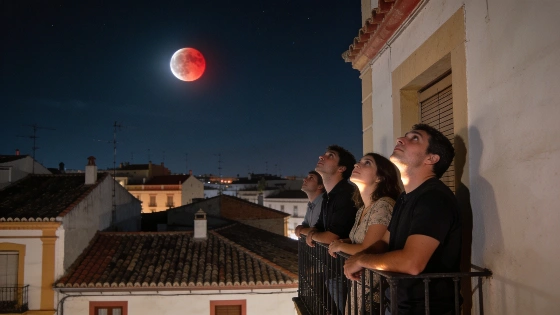
A partial lunar eclipse turned the Moon red and was visible throughout Spain. The phenomenon marks the start of a rare astronomical series. More eclipses are expected in the coming years.
Spain witnessed a striking astronomical event overnight as a partial lunar eclipse cast a red glow over the Moon, drawing attention from observers nationwide. The phenomenon, visible from all regions of the country, occurred when the Earth moved between the Sun and the Moon, causing part of the lunar surface to pass through Earth's shadow and take on a reddish hue.
This partial eclipse is not an isolated occurrence but the beginning of a notable sequence of celestial events expected to unfold over the next two years. According to available information, Spain experienced similar astronomical spectacles earlier this summer, and the current eclipse signals the start of a historic series that will culminate in 2028.
The next major event in this sequence is scheduled for 2 August 2027, when a total solar eclipse will be visible, following the pattern set by the total solar eclipse observed on 12 August. The series is set to conclude with an annular eclipse in January 2028, offering further opportunities for skywatchers across the country.
Lunar eclipses occur when the Earth aligns directly between the Sun and the Moon, blocking sunlight and casting a shadow on the lunar surface. The reddish tint, often referred to as a 'blood moon,' results from Earth's atmosphere filtering and refracting sunlight, allowing only red wavelengths to reach the Moon. Such events are relatively rare and tend to attract significant public interest, especially when visible across large areas like the entire Spanish territory.
For context, Spain's geographical position and generally clear summer skies make it an ideal location for observing astronomical phenomena. The upcoming eclipses are expected to draw attention from both amateur and professional astronomers, as well as the general public. These events not only offer a visual spectacle but also provide valuable opportunities for scientific observation and public engagement with astronomy. The anticipation surrounding the 2027 and 2028 eclipses highlights the growing interest in space-related events among Spain's population.