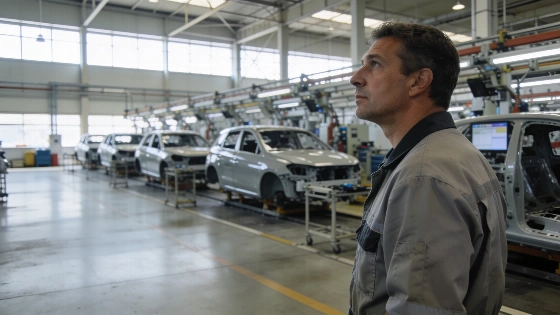
Production stoppages began at Renault plants in Castilla y León on 1 October. Around 5,500 workers are affected as weak European demand forces the company to reduce output.
On 1 October 2026, Renault began stopping work at its factories in Valladolid and Palencia. More than 5,000 workers are affected, according to RTVE. The pause began only a week after Renault announced five new models for Spain and a €600 million industrial plan through 2030.
Palencia will remain idle for 18 days. Renault says weaker European demand has cut sales and forced the company to match production with them. Reuters cited the same reason in its report on Renault's restructuring in Spain.
The production pauses began on 1 October 2026 and affect approximately 5,500 Renault workers in Valladolid and Palencia, according to RTVE.
The cost will not stop when the factories reopen. Carlos Rodríguez of CSIF says workers may have to make up the lost time on Saturdays. That could create six-day work stretches at high production rates and make it harder to maintain a normal life outside work.
Renault can order these stoppages under the flexibility rules in its collective agreement for 2026-2028. The agreement includes a bank of hours and production breaks for periods of falling or changing demand. Those rules now support the current shutdowns.
Unions are split.
UGT and CC. OO. backed the agreement signed in June. SCP, CGT and CSIF rejected it. The unions that opposed the deal said its pay, labour and social measures did not go far enough. Miguel Ángel León of CGT called the recovery of only 400 euros over three years inadequate.
Local and regional reports describe a prolonged stoppage in Palencia and a series of Friday production pauses at Valladolid during October. The schedule reflects the temporary reduction of output while the plants wait for the next generation of models.
UGT and CC. OO. call the current period a temporary production valley. Adolfo Arnaiz of UGT warns that the plants face two difficult years before the new vehicles assigned to Valladolid and Palencia enter production. Sergio García of CC. OO. accepts the need for flexibility, but says it must stay temporary and protect every job.
CGT and CSIF also question how the stoppages were decided and how often they are being used. Their representatives say Renault did not formally explain the latest decision. They accuse the company of using technical breaks as a regular tool. León says an 18-day halt in Palencia is hard to square with promises of future stability.
Renault announced its industrial plan on 24 September. It includes five new vehicles, two of them electric, plus a battery assembly line in Valladolid. Reuters reports that the €600 million investment will adapt the Spanish plants for new models and electric-vehicle production. The programme is expected to support five models at the Valladolid and Palencia sites by 2030.
The plan gives the factories a production target, but it does not ease the immediate pressure on employees. The new models are still ahead. Current output is already falling.
That contrast is clear. Renault is preparing long-term capacity in Spain while dealing with a fall in European demand. Workers may later have to repay the time lost during the stoppages.
Valladolid and Palencia have a future under the plan. For now, employees carry much of the cost of the production gap. Renault can point to weak demand, but repeated stoppages and Saturday recovery shifts weaken the job security promised by the new investment. The test will be whether the new models arrive with stable employment instead of another round of cuts.