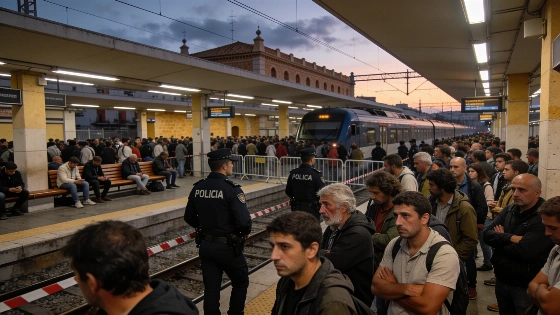
Thousands faced long waits at Tarragona stations after the eclipse. Renfe says it lacked extra trains to handle the surge. Police restricted access for safety as platforms filled beyond capacity.
Severe overcrowding hit train stations in Tarragona province on Wednesday after the solar eclipse drew thousands of visitors to the region. Renfe, Spain’s main rail operator, has attributed the chaos to a lack of available trains, insisting it had already doubled capacity but could not deploy more rolling stock to meet the exceptional demand.
Stations in Torredembarra, Altafulla, and especially Tarragona city were overwhelmed as crowds tried to return home following the eclipse, which had been widely promoted as a prime viewing event in Catalonia. The situation escalated to the point where Mossos d’Esquadra officers were forced to restrict access to platforms, citing safety concerns as waiting areas became dangerously congested.
Despite months of advance notice and official recommendations from the Generalitat and Servei Català del Trànsit to use public transport for eclipse travel, the rail network struggled to cope. Renfe maintains that it was not a matter of poor planning, but rather a physical limit on available trains. On the R16 line, which connects Barcelona with Terres de l’Ebre and stops at the affected stations, the company says it increased capacity from the usual 1,800 to 3,600 seats. The R15 line, linking Barcelona and Reus, saw a 60% boost to 1,600 seats. Still, these measures fell short as more than 26,000 people gathered in Tarragona alone to witness the phenomenon.
Throughout the afternoon and evening, scenes of confusion and frustration unfolded. Passengers jostled for space at Barcelona Sants station and later at Tarragona, with many forced to wait hours for a train. Civil Protection activated a pre-alert for the Ferrocat plan due to the scale of the crowds at Tortosa, Tarragona, and Altafulla stations. Normal service was not restored until after midnight, by which time traffic on the AP7 motorway had also begun to ease following heavy congestion.
David Andrés, head of operations for Rodalies, explained on Catalunya Ràdio and Ser Catalunya that the collapse was caused by the limited number of trains available. He stressed that the deployment was the maximum possible given the need to maintain service on other lines across Catalonia. To ensure no one was left stranded, Renfe dispatched a special train late at night, repurposing a convoy from the R11 line to collect remaining passengers from southern stations.
This incident highlights the ongoing challenges facing Spain’s regional rail network during major public events. Similar issues have arisen in the past, such as when weather disruptions or infrastructure failures have led to mass delays and cancellations. For example, during a recent eclipse event in Asturias, poor weather left crowds disappointed, as reported in coverage of the Vega beach gathering.
Spain’s rail infrastructure, particularly in Catalonia, has faced criticism for its limited flexibility during surges in demand. While Renfe can increase capacity to a point, the number of trains and available staff remains a bottleneck. The company’s response to the Tarragona incident underscores the need for better contingency planning as public interest in large-scale events continues to grow. For now, the episode serves as a reminder of the strain that extraordinary occasions can place on everyday transport systems, especially when recommendations to use public transit are widely followed.