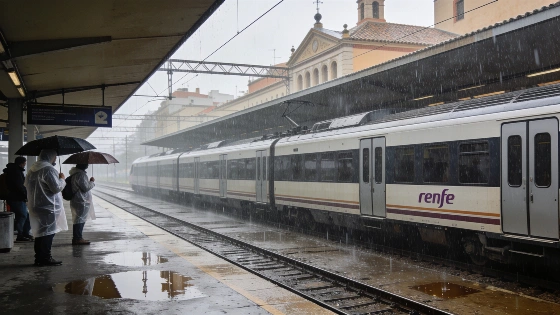
Renfe has suspended commuter rail services in Valencia and connections to Catalonia after AEMET issued a red alert for extreme rainfall. The shutdown comes as parts of eastern Spain brace for up to 90 litres of rain per hour and the risk of flash floods.
Trains stopped running in Valencia on October 1. Renfe shut down Cercanías commuter lines and key routes to Catalonia after AEMET, Spain's meteorological agency, issued a red alert for violent storms. The order hit thousands of daily commuters. Many scrambled to find other ways to travel as the worst weather of the season hit the eastern coast. Renfe and the Ministry of Transport confirmed the suspension started at 18:00. It covered not just Cercanías, but also Media Distancia and some long-distance trains heading toward Catalonia.
Cold air clashed with humid Mediterranean winds. That set off sudden, heavy rain. AEMET kept its highest-level warnings in place for Tarragona and Castellón. Rainfall could reach 90 litres per square metre in just one hour. Some places might see 250 litres in half a day. That much water could flood low-lying neighborhoods, dry riverbeds, and city streets not built for this kind of storm. The main Cercanías lines affected were C1 (Valencia-Gandía), C2 (Valencia-Xàtiva-Moixent), C3 (Valencia-Buñol-Utiel), and C6 (Valencia-Castellón). EFE and Euronews reported these details based on Renfe's official updates.
The red alert issued by AEMET on October 1 covered not only Valencia but also Castellón and Tarragona, with forecasts of up to 90 l/m² per hour in some areas.
The danger stretched south. Valencia and Alicante faced forecasts of up to 60 litres per square metre in a single hour along the coast. Murcia, Ibiza, Formentera, Almería, and Granada all received weather advisories for heavy rain and storms. The unstable weather was expected to move inland toward Madrid, Castilla-La Mancha, Castilla y León, Aragón, and Extremadura as the day went on. Even Madrid could get 20 litres per hour, with hail and strong winds possible. AEMET bulletins, cited by national media, said the worst would likely hit late on October 1 and into Friday, October 2. The heaviest rain was expected to shift toward Catalonia and the Balearic Islands.
Renfe’s cancellations, triggered by the red alert, hit several lines in Valencia and the routes to Catalonia. The company did not release a full list of affected trains. The shutdown shows how risky extreme weather can be for rail operations. Flash floods and landslides can strike fast. For travelers, the timing was bad. The region’s main transport routes stopped just as the storm front grew stronger. Local and national news reported on the morning of October 2 that red warnings and travel restrictions were still in place. Renfe said it would restore service gradually as the weather improved.
AEMET expects the worst rain to move toward Catalonia, the Balearic Islands, and other Mediterranean areas on Saturday. By Sunday, a high-altitude isolated depression—a dana—could settle west of the peninsula. That could bring more showers and storms into the next week. The forecast is still uncertain. Current models suggest the unstable weather could last through midweek, but not as fierce as now.
The weather emergency led to not only rail suspensions but also widespread restrictions across Catalonia, the Valencian Community, Murcia, the Balearic Islands, and parts of inland Spain, highlighting the scale of this severe rainfall episode on the country’s eastern flank.
This shutdown is part of a pattern. Spain has seen more wild weather in recent years. Earlier this year, sudden temperature swings and violent storms swept the country, as covered in the previous report. The shift from late-summer heat to autumn storms can happen fast, especially along the Mediterranean.
Renfe acted quickly after AEMET’s red alert. The move was disruptive but necessary to keep passengers and rail infrastructure safe from flash floods and storm damage. The scale of the cancellations shows how exposed Spain’s transport network is to extreme weather. It also shows why better emergency plans are needed as climate patterns become less predictable. For now, travelers in eastern Spain face a weekend of delays and uncertainty. Trains are stopped. The rain keeps falling.