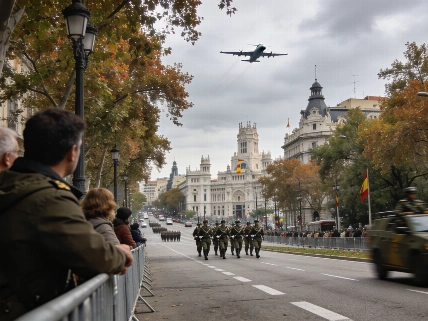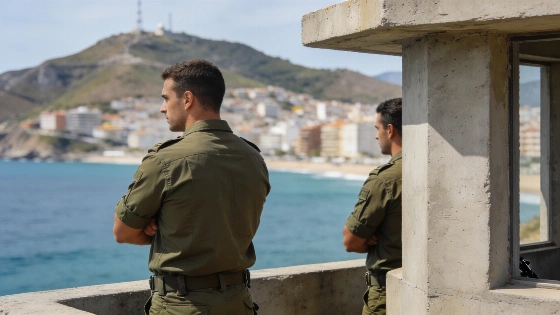
Margarita Robles reaffirmed Spain’s position on Ceuta and Melilla while addressing troops abroad. Spain is maintaining 17 missions with about 3,000 personnel across four continents.
The annual military videoconference was held on 11 October, one day before Spain’s National Day. Margarita Robles used it to reaffirm that Ceuta and Melilla are Spanish territory.
For the first time, the Comandancia General de Ceuta joined the event through a direct connection. According to Press Digital, the Defence minister thanked deployed personnel and described the two cities as unequivocally Spanish.
The political statement came with an operational update. The Mando Operativo de Ceuta reported surveillance and deterrence activity carried out in the city to ease concern among the local population. Robles praised the unit and defended it against criticism she attributed to a lack of understanding.
On 7 October 2026, the Spanish frigates Navarra and Cristóbal Colón joined NATO’s standing maritime group SNMG-2, continuing patrol activity in the Mediterranean, the Gulf of Cádiz and the eastern Atlantic.
The meeting placed Ceuta and Melilla inside a wider account of Spain’s overseas military role. Robles highlighted Spanish forces involved in European and African security operations. The emphasis came as Spain prepared for a visit by King Felipe VI and Queen Letizia to both cities, amid debate over their place in the security architecture of the European Union and NATO.
More than 3,000 service members are expected to remain deployed across four continents in 2026. Spain is participating in 17 missions and continues to command EUNAVFOR Atalanta and NMI in Iraq. Spanish personnel also serve in the Baltic countries. Others are deployed in Ukraine, Romania, Lebanon, Somalia and Iraq.
Independent media reported those figures. A separate Defence Ministry release with a full breakdown of all 17 missions was not identified in the available material.
The missions operate under several international frameworks. Under a United Nations mandate, Spanish forces lead the eastern sector of the operation in Lebanon. They also contribute to the United Nations mission in Colombia. Within NATO, Spain is due to lead the FLF-Eslovaquia battlegroup in 2026 under the Alliance’s new force model.
The EU Political and Security Committee decided on 24 September 2026 that, from 10 October, command of EUNAVFOR Atalanta would pass to Portuguese Commodore José João Rodrigues Pedre. The decision repealed the previous appointment decision and clarifies the operation’s current command structure.
Spain also contributes to NATO’s permanent naval forces SNMG and SNMCMG. Its deployments include air surveillance in Eap-Rumania, along with air defence support through BAP in the Baltic countries and A/T-Turquía. The Defence Ministry has also cited Spanish participation in every European Union military mission in Africa mentioned in its material, including deployments in the Central African Republic, Somalia and Senegal.
Operation Atalanta remains a major part of that network. It combats piracy in the Indian Ocean with personnel and equipment from the Armada and the Ejército del Aire y del Espacio, directed from the ES-OHQ at Base Naval de Rota. The latest EU command decision places Spain’s role alongside a change in senior multinational leadership. It does not establish a permanent Spanish command.
Robles said Spain cannot remain indifferent to security in Ukraine or on the southern flank. She presented deployed personnel as representatives of Spain and the European Union and described the country as a reliable NATO ally.
In October, King Felipe VI said an attack or threat against one EU member affects the Union as a whole. He referred to Spanish deployments in Latvia, Slovakia and Romania, as well as contributions to NATO air defence and the northern flank.
Press Digital reported that the videoconference had been moved from 12 October to 11 October so the minister could hold a calmer conversation with the troops.
The available reporting confirms the political setting around Ceuta and Melilla. It does not independently establish a specific new threat or an operational change in either city. It also does not identify a separate official Defence Ministry release containing the full videoconference transcript or detailed figures for each of the 17 missions.