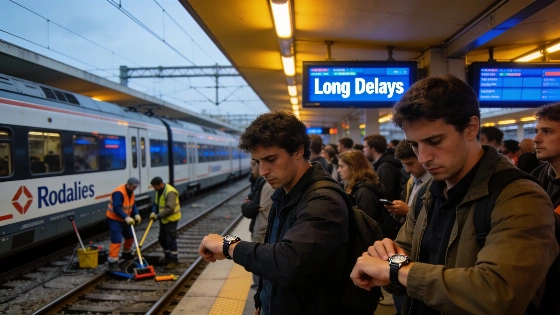
Six months after the Gelida accident, Rodalies still faces major delays and cancellations. Passenger numbers have partially recovered, but service remains unreliable. June data shows half of trains miss scheduled times.
Rodalies, Catalonia’s main commuter rail network, continues to face severe operational challenges six months after the catastrophic Gelida accident. Despite a partial rebound in passenger numbers, the system remains plagued by chronic delays and frequent cancellations, with June figures revealing that only about half of trains arrived on time. The crisis began on January 20, 2026, when a retaining wall from the AP7 motorway collapsed onto the R4 line near Gelida, causing a fatal collision that killed a trainee driver and injured several others. The incident forced a complete shutdown of the Rodalies network for urgent safety inspections and triggered months of emergency repairs, speed restrictions, and substitute bus services.
Although the Generalitat and Renfe Viajeros had just established a joint company to oversee the network, the transition of responsibilities is not expected until 2027. In the meantime, passengers have endured daily disruptions. The initial impact was dramatic: in January, Rodalies saw a 31.6% drop in ridership compared to the previous year, with only 6.16 million journeys recorded versus 9.01 million in January 2025. February saw an even steeper decline, with passenger numbers falling by 33.1%. Recovery began in March, but demand remained 11.5% below 2025 levels. April marked a brief turning point, as free travel—introduced by the Generalitat—helped push ridership to 9.66 million, surpassing the previous year for the first time since the accident. However, this momentum faded after the end of the fare exemption on May 9, and both May and June saw a renewed dip, stabilizing at around nine million monthly passengers—still below pre-crisis peaks.
Service reliability remains a major concern. In June, Rodalies operated 17,698 train services, but only 50.5% adhered to the scheduled timetable. While this is an improvement over March and April, it means that nearly every second train was delayed. The average delay for late trains in June reached 22.3 minutes, up from 20.4 minutes in May and similar to the 21.1-minute average in January. February was the worst month, with delayed trains averaging 26.6 minutes behind schedule. Even when including punctual and early arrivals, the overall average delay in June was 1.5 minutes per train. The network’s performance indicator for completed versus scheduled services also highlights the ongoing difficulties: after dropping to just 38% in the immediate aftermath of the accident, service fulfillment gradually improved, reaching 94.8% in June. Still, more than 5% of planned trains were cancelled that month.
External factors have compounded the operational strain. In June, 75.2% of all delay minutes were attributed to causes outside Renfe’s control, such as infrastructure failures, cable theft, suicides, fires, adverse weather, and graffiti-related disruptions. The remaining 24.8% were linked to Renfe itself. Notably, recent copper thefts at La Sagrera and La Plana-Picamoixons led to further interruptions, halting entire sections of the network. The infrastructure, spanning 1,120 kilometers and serving 166 municipalities with 200 stations and 271 trains, has struggled to recover from decades of underinvestment and the cumulative impact of accidents and ongoing works.
Comparisons with Madrid’s Cercanías network underscore the scale of Rodalies’ difficulties. In June, Madrid handled 35,481 train services and around 21 million passengers, with an average delay of just 0.5 minutes per train. In contrast, Rodalies’ average delay was three times higher, and only 50.5% of its trains were punctual, compared to 65.4% in Madrid. Service regularity and fulfillment also lagged behind the capital’s figures. The persistent issues in Catalonia’s rail system echo broader concerns about infrastructure resilience, as seen in other recent incidents such as the partial reopening of Barcelona’s L9 metro line after a tunnel collapse in Sant Gervasi.
Rodalies’ ongoing struggles highlight the vulnerability of critical transport infrastructure to both sudden accidents and long-term neglect. The network’s slow recovery, despite partial rebounds in passenger numbers, signals the need for sustained investment and effective management. For now, daily commuters in Catalonia continue to face uncertainty, with punctuality and reliability still far from restored.