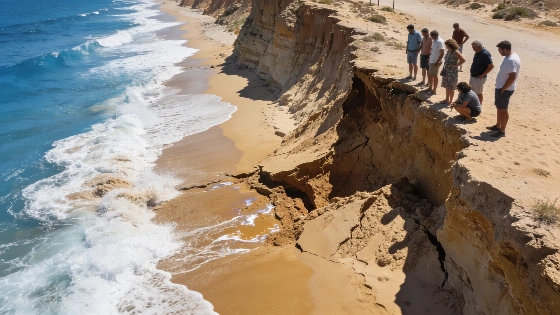
Freshly deposited sand on Sagunto’s northern beaches is rapidly eroding after the first waves, leaving steep drops and renewed safety concerns. Residents demand structural solutions to protect the coastline before autumn storms arrive.
Just days after more than a million cubic meters of sand were added to the northern beaches of Sagunto, residents are sounding the alarm: the new sand is already being swept away by the first significant waves. The rapid erosion has left sharp drops along the shoreline, with some sections in Corinto now showing sand cliffs up to a meter and a half high. These sudden changes are making access to the water difficult, especially for older people, children, and those with limited mobility.
The sand replenishment, funded by European sources, was intended to restore beaches in Almardà, Corinto, and Malvarrosa after years of coastal retreat. For many locals, the project was long overdue. But as summer approaches, the speed at which the sand is disappearing has reignited concerns about both safety and the effectiveness of such interventions.
Steep Drops and Safety Risks
According to Amparo Peris, president of the Asociación Vecinal de Almardà, Corinto y Malvarrosa, the situation is a "cold shower" for the community. She describes the new sand formations as "enormous steps" that prevent residents from enjoying the beach as intended. The association argues that simply adding sand is not enough—without protective measures, the sea will continue to reclaim the material, undermining the investment and leaving the coastline exposed.
Fears Ahead of Autumn Storms
Residents are particularly worried about what will happen when autumn and winter storms arrive. Past episodes of erosion have left beaches nearly vanished, damaged infrastructure, and even allowed seawater to reach homes and campsites. The Ministry for Ecological Transition has acknowledged that this stretch of coast faces severe erosion, driven by disrupted sediment flows, urban development, and changes to local port infrastructure. The ministry also notes a rise in gravel deposits, which further affects comfort and safety for beachgoers.
Calls for Structural Solutions
The local association insists that the rapid loss of sand proves the need for more than just periodic replenishment. Their main proposal is to install submerged artificial reefs parallel to the coast. These structures, they argue, would help break the force of incoming waves and retain sand, while still allowing natural coastal dynamics to continue. The group also points out that such reefs could boost marine biodiversity and attract tourism linked to diving.
For now, residents are urging the Ministry to consider long-term, structural solutions rather than relying solely on new sand deliveries. While the recent regeneration was welcomed, the community is clear: without stable protection, Almardà, Corinto, and Malvarrosa will remain at risk.
Coastal erosion is a growing challenge for many Mediterranean towns, as climate change and human activity continue to reshape Spain’s beaches. The situation in Sagunto highlights the urgent need for sustainable strategies that balance environmental, social, and economic priorities.