Pedro Sánchez attacks leaders he says have abandoned UN principles. He condemns illegal wars and civilian massacres while defending Spain's actions on Ukraine, Gaza and Iran.
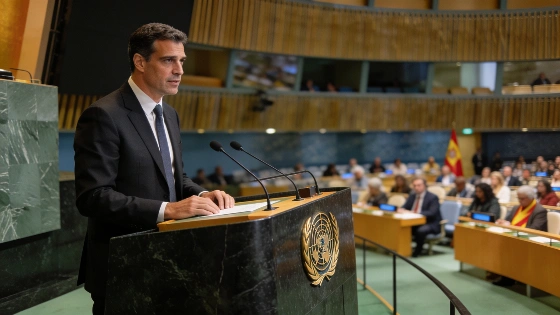
Pedro Sánchez used the United Nations General Assembly to launch his sharpest attack yet on leaders he says have abandoned the organisation's founding values. He did not name Donald Trump at first. Instead, he focused more directly on Benjamin Netanyahu. Sánchez described a political force driven by selfishness, ignorance and cruelty. He linked it to illegal wars, civilian massacres and the abandonment of people facing poverty and disease. Reports by RTVE and Anadolu described the speech as a direct challenge to leaders tied to that worldview.
The Spanish prime minister's warning was aimed at more than one government.
Spain’s government officially recorded Pedro Sánchez’s participation in the opening of the 81st UN General Assembly on 22 September 2026.
His criticism also reached Vladímir Putin and leaders who reject the principles behind the UN and the goals of Agenda 2030. Sánchez accused them of treating international relations as a zero-sum contest. In that view, one country can prosper only when another loses. He also condemned contempt for science and the belief that powerful states can abuse others without cooperation. He tied that rhetoric directly to Trump, Netanyahu and Putin, presenting them as examples of a wider political force that is weakening international cooperation.
The speech's harshest image focused on the human cost. Sánchez referred to hungry children and hospitals reduced to rubble. He said they showed a cruelty that no longer responds to suffering. During the past eight years, he said, he had watched reactionary forces grow stronger and take power in many places. He said those forces had launched wars contrary to international law. They had treated millions of people like livestock, withdrawn aid from people facing poverty and disease, polluted the atmosphere and oceans, and sought to destroy the organisation itself.
For Israel's prime minister, the message was unmistakable.
According to J Street’s overview of Spain’s measures over the Gaza war, Madrid has combined an arms embargo with restrictions on fuel transit for the Israeli military through Spanish ports. Spain has also barred state aircraft carrying defence cargo and prohibited entry to several people linked to the war.
Sánchez presented Spain's record as a rebuttal. He said Madrid had opposed wars of aggression wherever they emerged, including in Ukraine, Lebanon and Iran. He said Spain had rejected the demand to raise military spending to 5%. It had sanctioned Russian aggressors, imposed an arms embargo on Israel, prevented its territory from being used to deploy an attack contrary to international law, and condemned what he described as the genocide Netanyahu continues to perpetrate in Gaza. Anadolu reported that Sánchez again used the term "genocide" for the situation in Gaza and condemned the conduct of Netanyahu's government.
That list gave the speech its clearest practical point. Sánchez was not only defending multilateral institutions in abstract terms. He pointed to sanctions, decisions on arms transfers and the use of Spanish territory as examples of Spain acting on its stated position. His language toward Netanyahu was explicit. His message to Trump was more carefully veiled. The additional restrictions described by J Street show that Spain's position also includes logistical and diplomatic measures beyond the arms embargo.
The speech also fitted into a wider campaign for institutional reform. Sánchez called for a reformed Security Council with fairer regional representation. He argued that the permanent members' veto should be abolished. His proposal supported his central claim: the UN can retain authority only if its rules are applied more consistently and its decision-making structure is seen as representative.
In the days before the address, Sánchez presented that approach as a defence of multilateralism rather than a one-off confrontation. EFE reported that he met UN Secretary-General António Guterres on 22 September. Sánchez praised the UN chief and discussed protecting the multilateral order, sustainable development and a fairer international financial architecture.
Sánchez closed by turning to future generations. He said children in the years ahead would judge what governments did when countries began breaking rules and others chose to look away. Spain's prime minister said he wanted his country to be able to show that it had kept fighting for a more peaceful, sustainable and just world.
The speech left a clear political record. Sánchez placed Spain against aggression and civilian massacres and tied that position to concrete measures he listed before the General Assembly. Its force comes from the contrast between those actions and the leaders he accused of abandoning cooperation. The Spanish government is presenting multilateralism not as a slogan, but as the standard for judging political decisions.