A 29-member international team has drilled over 500 meters into West Antarctica, retrieving a unique sediment core. The find offers a rare geological record spanning 23 million years and could reshape climate predictions.
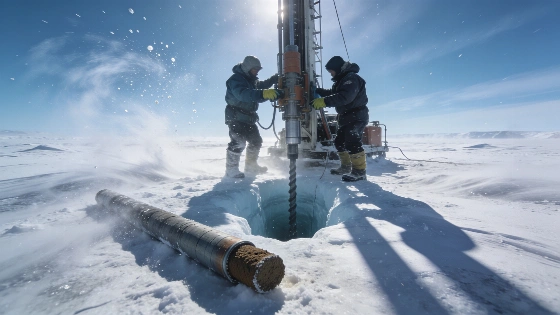
In a breakthrough for climate science, an international team of 29 researchers and engineers has drilled more than half a kilometer through the ice of West Antarctica, retrieving a 228-meter sediment core that documents over 23 million years of Earth's climate history. The operation, part of the SWAIS2C project, was carried out at Crary Ice Rise, a remote ice dome located roughly 700 kilometers from the nearest research stations on the Ross Ice Shelf.
This is the first time such an extensive geological record has been extracted from this region. The core, composed of alternating layers of mud and rock, preserves evidence of dramatic environmental changes, including periods when global temperatures were significantly higher than today. According to the project's scientific leads, the data will be crucial for understanding how the West Antarctic Ice Sheet and the Ross Ice Shelf might respond if global temperatures rise above 2°C compared to pre-industrial levels.
The drilling was accomplished using a hot water jet system, allowing the team to penetrate 523 meters of solid ice before reaching the sediment below. Analysis of the core has already revealed a complex history: some layers indicate conditions similar to those beneath today's ice sheet, while others suggest open ocean environments, floating ice shelves, or even periods of iceberg calving at the ice margin. These findings point to significant variability in the region's climate and ice cover over millions of years.
Researchers from ETH Zurich, the Swiss Federal Institute for Forest, Snow and Landscape Research (WSL), and Te Herenga Waka (Victoria University of Wellington) jointly led the project. The initial results, as reported by ETH Zurich, highlight the importance of the core for reconstructing past warm periods on Earth and for refining models that predict the pace of Antarctic ice melt in a warming world.
The SWAIS2C (Sensitivity of the West Antarctic Ice Sheet to 2°C) initiative aims to clarify how sensitive the Antarctic ice is to temperature increases, a question with direct implications for global sea level rise. The Crary Ice Rise site was chosen for its strategic position at the inner margin of the Ross Ice Shelf, where past changes in ice dynamics are likely to be well recorded in the sediments below. The core's length and preservation make it the most comprehensive archive of its kind from West Antarctica.
For context, the Antarctic ice sheet holds enough frozen water to raise global sea levels by several meters if it were to melt entirely. Understanding its stability is a priority for climate researchers worldwide. Previous drilling projects in Antarctica have recovered ice and sediment cores, but few have reached such depths or covered such a long timespan in this sector of the continent. The new core offers a rare opportunity to study how the ice sheet responded to past episodes of natural warming, which may help scientists anticipate future changes as global temperatures continue to rise.
While the full analysis of the sediment core will take time, early indications suggest that West Antarctica has experienced repeated cycles of ice advance and retreat, influenced by both oceanic and atmospheric conditions. This knowledge is expected to inform not only scientific understanding but also policy decisions related to climate adaptation and coastal planning in countries vulnerable to sea level rise, including Spain and other European nations.