A new study projects that Earth's plant life could survive for nearly 1.9 billion more years. Rising solar radiation and falling CO₂ levels will eventually make photosynthesis impossible. The timeline challenges previous estimates.
Researchers have calculated a new, much longer timeline for the survival of plant life on Earth. According to a study published in JGR Atmospheres, the planet's vegetation could persist for up to 1.9 billion more years before environmental changes make photosynthesis impossible. The work, led by Jacob Haqq-Misra and Eric Wolf from Blue Marble Space, focuses on how the Sun's gradual brightening and the decline of atmospheric CO₂ will ultimately end the era of green life on Earth.
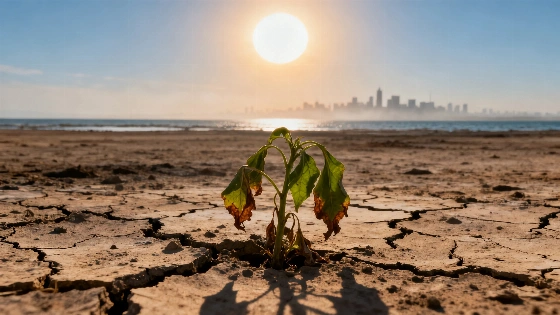
The study outlines two main scenarios. In the first, the Sun's increasing brightness steadily raises Earth's surface temperature. Over the next 1.5 billion years, average temperatures could climb by more than 20 degrees Celsius. After that, the warming accelerates, adding another 40 degrees in the following 500 million years. Such extreme heat would surpass the tolerance of even the most resilient plants, placing the extinction of vegetation around 1,870,000,000 years from now. The authors note, however, that predictions over such vast timescales carry significant uncertainty.
The second scenario considers the impact of declining atmospheric CO₂. Geological and atmospheric processes could reduce CO₂ from current levels of over 400 parts per million to just above 30 parts per million within a billion years. This drop would deprive most plants of the carbon they need for photosynthesis. Even under the most favorable conditions, plant life would struggle to survive beyond 1.84 billion years. The study also suggests that Earth's oceans could evaporate in about 1.5 billion years, though microbial life might persist underground for longer.
Unlike sudden mass extinctions of the past, the end of plant life is expected to be a slow process, marked by a gradual decline in habitable conditions. The researchers emphasize that the extinction of vegetation will not happen overnight but will unfold over millions of years as the planet becomes less hospitable. For context, previous estimates placed the end of plant life much sooner, with some predicting a limit within 100 million years and others extending it to about a billion years. This new model significantly extends the timeline, though it remains subject to the unpredictable nature of planetary and solar evolution.
For Spain and the rest of the world, these findings highlight the immense timescales involved in planetary change. While the extinction of plant life is not an immediate concern, the study underscores the delicate balance that sustains Earth's biosphere. As a reference, the current concentration of atmospheric CO₂ is already a topic of debate due to its role in climate change, but the processes described in the study operate on a scale far beyond human lifespans or policy planning. The research provides a long-term perspective on Earth's future, reminding us of the planet's evolving environment and the eventual limits of life as we know it.