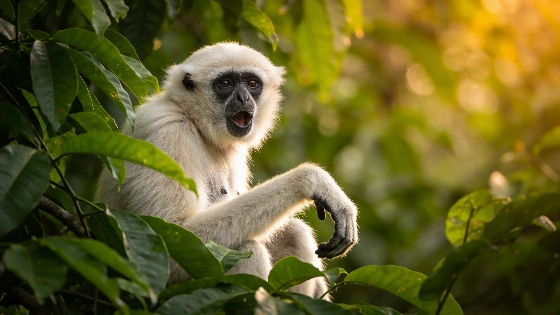
Noise from roads and human infrastructure is changing the calls of white-handed gibbons (Hylobates lar). A study reports that the animals emit fewer sounds, affecting how they search for food. Birds and squirrels also rely on the gibbons' alarm signals.
Research elsewhere in the selection examines how animal health and conservation depend on close biological evidence. A study of 28 wild capybaras in Colombia found wide variation in their microbiota. Water availability and diet may influence the microorganisms living inside them. Knowing what is «normal» could help monitor the health of different populations.
In Switzerland, the Eurasian lynx population grew from 20 to 360 after its recovery was considered a conservation success. A study has since identified a serious issue in one population: an inherited genetic variant causes a fatal disease. Conservation programmes need to consider the finding when assessing reintroduction.
Sea turtles present a different research challenge. In the Canary Islands, the Centro de Recuperación de Fauna Marina de Taliarte and ADS Biodiversidad run a long-term loggerhead turtle programme focused on the animals' «años perdidos» in open water. The programme began on 14 September 2006, when more than 600 loggerhead eggs from Cabo Verde were flown to the islands. Researchers continue to monitor turtles linked to that intervention; around two decades later, 11 remained at the facilities. The programme gathers morphometric, biochemical, hormonal, genetic and stable-isotope data. Microchips identify individual turtles. Some released animals are also monitored to record their movements and oceanographic conditions.
The space images move from a meteor shower to a young star cluster. A photograph over the Longma Observatory in China shows a Leonid meteor. The Leonids come from debris left by comet 55P/Tempel-Tuttle, which Earth encounters each November. According to the International Meteor Organization, the shower is active from 6 to 30 November and peaks around 17 to 18 November. Its apparent radiant lies in the constellation Leo. The streaks form as particles enter the atmosphere at close to 71 kilometres per second and ablate.
NGC 1866 is a young stellar cluster in the Large Magellanic Cloud, a neighbouring galaxy of the Milky Way. The cluster may contain several generations of stars. National Geographic's selection includes it among 25 images published to explore the universe.
The collection also reaches back to 1964, when Jacques Cousteau set out to spend a month beneath the Red Sea. National Geographic has revived a photograph from its print edition showing the expedition, which Cousteau recounted in a text. The publication has also covered a Seville art retrospective.