Spain’s car market in 2026 looks nothing like it did just a few years ago. With 71 brands on sale and a wave of Chinese newcomers, drivers are left guessing at strange logos and names. Here’s how the landscape has changed.
Walk down a street in Spain and you’ll spot car badges you’ve never seen before. Two years ago, names like EBRO, Omoda, and Jaecoo meant nothing to most drivers. Now, according to DGT data for 2026, these brands are among the most registered in the country. Even car enthusiasts are snapping photos of odd emblems, hoping their phones can tell them what they’re looking at.
There are 71 car brands officially for sale in Spain. Ten years ago, that number would have sounded impossible. The main reason? Chinese manufacturers. Out of those 71 brands, 21 are based in China. No other country comes close. The UK has nine. Italy and Japan each have eight. Germany has six. This isn’t just about numbers. The look of the street has changed. Old, familiar logos now compete with bold new symbols. Many people have no idea what they’re seeing.
By August 2026, Chinese brands accounted for approximately 120,000 new car registrations in Spain, representing about 14.5% of the market—significantly more than in 2023.
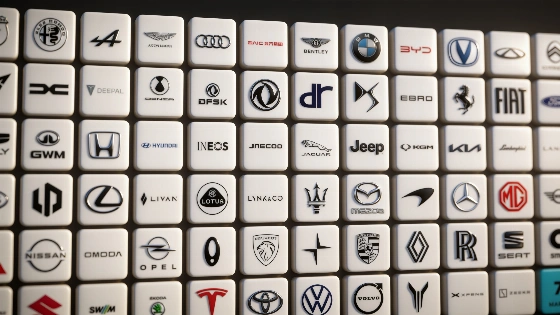
Trying to figure out what’s what? It’s not easy. Some badges are almost impossible to decode. The “KN” logo is actually Kia. The letters run together in a single line. A V inside an oval? That’s Changan. A flat X means XPeng. Dacia’s logo, changed in 2021, uses a mirrored D and C. Leapmotor’s badge looks like “LP.” Chery’s oval with an A or triangle can be mistaken for Infiniti if the lines meet like a road. Even the letter H is split: Hyundai’s is slanted, Honda’s stands upright in a rectangle.
Some brands dropped symbols and just use their name in big letters. Omoda, Jaecoo, EBRO, BYD, and others went this route. Classic shapes still show up: wings for Aston Martin and Bentley, animals for Ferrari and Peugeot, stars for Mercedes-Benz and Subaru, and geometric shapes for Renault and Mitsubishi. The street is a jumble of old and new. It’s easy to get lost.
The variety goes beyond logos. The new guide lists every brand from Abarth to Zeekr. It covers where they come from, what their badges mean, and which models you can buy in Spain. Some brands don’t sell new cars anymore, but their vehicles are still on the road. That includes Aiways, SsangYong, Chevrolet, Daewoo, Saab, Rover, and Infiniti.
Omoda and Jaecoo have become some of the fastest-growing brands in Spain, reaching a combined 25,465 registrations by August 2026, largely due to the popularity of their hybrid and plug-in hybrid models.
For buyers, it’s a real puzzle. You can’t just look at a badge and know the brand. The guide suggests starting with the shape: letters, wings, animals, stars, ovals, or something else. Work from there. Even old brands have changed their look, making things trickier. As reported earlier, Omoda and Jaecoo have shot up the sales charts. New names can go mainstream fast.
The list is built on hard numbers. It uses 2026 DGT registration microdata (provisional through September) and the brands listed on Carwow. Logos come from Wikimedia Commons and Carwow, with special credit for Changan and Škoda. All trademarks and logos belong to their owners.
Spain’s car market is in flux. Old brands and newcomers now fight for attention. Visual identity matters as much as price or performance. For drivers, the days of knowing every badge are gone. Curiosity helps. So does patience. Chinese brands are here to stay. New logos keep coming. The rules have changed. For many, that’s a challenge. For others, it’s a chance to try something new.