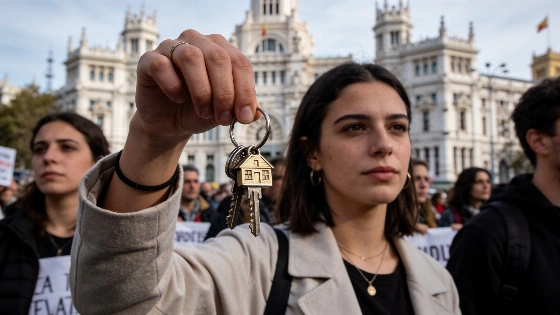
Madrid’s city center saw 70,000 people rally against housing injustice, with tenant unions demanding a general strike. The protest signals a powerful mobilization of the left, challenging both government and private interests amid looming electoral uncertainty.
Madrid’s Cibeles square filled with 70,000 people on Saturday as marchers raised keys and called for action on housing. It was Spain’s biggest housing rally in years.
The Sindicato de Inquilinas brought the crowd together with a blunt message: affordable homes and action now. Politicians, landlords, and global investment funds all stood in the crosshairs. The left is mobilizing and is not waiting for elections.
The protest began with Maricarmen, 87, who was evicted on September 23 after living in her home for more than seventy years. Reuters reported that her case sparked protests across Spain. Following a public outcry, movement leaders reached a deal allowing Maricarmen to stay in her apartment under her old rental terms. But the union says that is not enough: only a general strike will break the deadlock. "This is a warning to all," said spokesperson Valeria Racu. She made clear that protests will continue, whoever is in power. Talks with major unions CC OO and UGT are already under way to set a strike date. Racu said the timing would not depend on any snap election in November.
Reuters estimated the Madrid march at around 30,000 people on September 28. By the end of the month, protest camps and new actions had spread to other cities across Spain.
The slogans cut through the noise: "Right to a roof." "We need a general strike now." "This is class struggle, we cannot make peace." Anger was directed at more than the right: the coalition government faced heavy criticism for years of inaction. The union said, "Eight days of popular support have done more than eight years of progressive government." It also accused conservative leaders of giving in to "vulture funds."
This was the second huge protest in a week. The previous weekend, 25,000 people marched for Maricarmen. Now the focus has shifted beyond one eviction to a call for real change. The movement is spreading, with protests in Bilbao, Valencia, the Canary Islands, and many other cities. Spain’s housing crisis is now a flashpoint for political and social tension, as reported earlier.
The crowd was also diverse. Domestic workers’ unions spoke out about betrayal and racism, while early childhood educators promised to strike on October 14. Healthcare workers, young renters, and families joined them. Many feel the political class is ignoring them. "This should have been solved long before the decrees," said Clara, who came with her family. Sandra, who had to leave Madrid for Toledo because of high rents, said she would vote "with more fear than hope" if elections come soon.
On September 29, the Spanish government approved two new housing decrees aimed at easing the crisis. Euronews reported that protest groups said they would continue their campaign regardless of the cabinet’s decision. When Congress failed to ratify the decrees on October 1 and 2, tenant organizations stepped up pressure and called for further demonstrations; major unions CCOO and UGT publicly joined the cause.
Four columns of marchers met at Cibeles, keys waving in the air. The crowd called out the government and regional leaders such as Almeida and Ayuso. The Sindicato de Inquilinas said its Puerta del Sol camp would end, but street action would continue. Its plan is to organize in neighborhoods and take the movement to more cities.
Maricarmen’s eviction was the spark, and protests spread quickly. She was carried out on a stretcher. Hundreds of activists who had fought evictions for years suddenly gained new momentum. Within days, Puerta del Sol became the center of Spain’s housing fight, with tents and banners filling the square as protesters demanded rent controls and an end to forced removals.
Prime Minister Pedro Sánchez got the message. If he was waiting to see whether the left could mobilize before calling an early election, Saturday gave him the answer. The left is present, restless, and ready to push harder. The government’s last-minute decrees to stop evictions have not calmed the anger. Chants including "Where is the progressive government?" and "Minister landlord, you are on our list" rang out.
Spain’s housing crisis is no longer a quiet problem; it is a fight in the open. The coming weeks will test whether the government can win back trust as the streets and unions press to shape what comes next. Housing is now basic to Spain’s political battle.