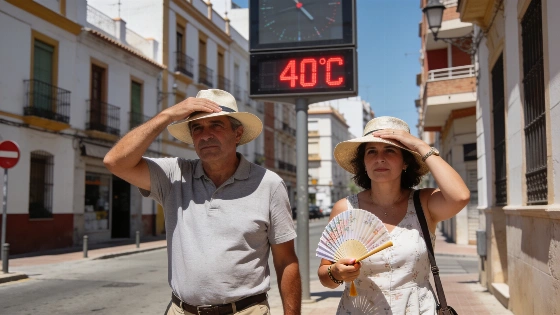
Spain faces a dramatic weather shift as maximum temperatures plunge across the north and center. The AEMET forecasts intense storms in the east and Balearic Islands, with hail and strong winds expected. The abrupt end to September’s heatwave signals a rapid transition to autumn conditions.
Northern and central Spain are about to see a sharp drop in temperatures, with the Agencia Estatal de Meteorología (AEMET) warning of a sudden cool-down starting Wednesday. Cities like Vitoria, Lugo, and Soria will struggle to reach 20 or 21 degrees, a big change from the lingering summer heat that has lasted through September. AEMET has issued orange weather alerts for Catalonia, Aragon, the Balearic Islands, and the Valencian Community, and yellow alerts for Andalusia, Castilla-La Mancha, and Murcia.
While the north prepares for colder days, the east and Balearic Islands are facing heavy rain and storms. Girona is under an orange alert, with up to 100 liters of rain per square meter possible in just 12 hours. Ibiza, Formentera, and Mallorca are also expected to see severe storms, hail, and strong winds. The Cantabrian coast and the Pyrenees will have steady rain and fog, and clouds will spread across the eastern mountains. RTVE and other Spanish news outlets report that thunderstorms are likely in at least seven autonomous communities, showing how widespread the current instability is.
Local weather agencies report that in Girona and Barcelona, rainfall could exceed 40 liters per square meter in just 30 minutes, with localized peaks of 60–90 liters in three hours.
Wednesday is the turning point. A high-altitude cold air trough, or "vaguada," will move across the peninsula, bringing widespread rain and a sharp temperature drop. In the north and interior, cities such as Ávila, León, Logroño, Palencia, Pamplona, Bilbao, Burgos, San Sebastián, Lugo, Oviedo, Soria, and Santander will see highs between 20 and 24 degrees. Vitoria is expected to be the coolest provincial capital, with a maximum of just 20 degrees. Meteorologists attribute this sudden change to an Atlantic trough, which is driving the cooling and unstable weather across much of Spain.
The south and southeast, meanwhile, will hold onto summer a bit longer. Cáceres, Cuenca, and Toledo are forecast to reach 33 degrees, with Huelva and Lleida close behind at 32. Alicante, Girona, and Melilla will be around 31, while Málaga, Palma, Tarragona, and Castellón de la Plana will see highs near 30 degrees. This north-south split highlights how unevenly autumn is arriving. AEMET notes the strong contrast, with the north and interior already feeling autumnal while the south and southeast still see summer-like highs of 30–33°C.
By Thursday, the cold air trough will have passed, leaving cooler, more autumn-like weather behind. Rain is still likely in the east and Mediterranean, with showers and cloud cover continuing. Central Spain will have high clouds, while the east could see more storms and local downpours. Maximum temperatures will level off but stay lower: Badajoz, Córdoba, and Sevilla will reach 32 degrees, while Granada, Jaén, Almería, and Santa Cruz de Tenerife will be at 29. Many other cities—including Madrid, Barcelona, Ceuta, Cuenca, Girona, Guadalajara, Huesca, and Tarragona—will see highs between 26 and 28 degrees. The coolest weather will remain in the north and interior, with Ávila, Bilbao, Lugo, Palencia, and Soria not expected to exceed 22 degrees.
Regional authorities in Catalonia have activated the Inuncat flood response plan due to the threat of intense rainfall, especially in the Barcelona and Girona areas. This measure follows official warnings of possible hail and very strong wind gusts, as confirmed by independent Spanish publications referencing AEMET.
This quick shift from late-summer heat to autumn chill shows how fast Spain's weather can change. Residents and travelers should be ready for sudden storms and temperature swings, especially in areas under weather alerts. As the country moves into autumn, the coming days will test both infrastructure and daily routines, with the unpredictable climate making itself felt across the peninsula.