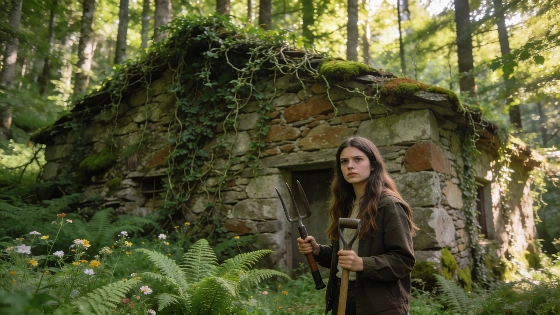
When María García first saw the overgrown stone house hidden in the Asturian forest, she was working a permanent sales job near Oviedo. The 26-year-old had a stable contract and decent conditions, but the COVID lockdown led her to question whether the security of city life was worth its pace and pressure. That pause prompted an uncommon decision: she quit her job, bought the abandoned house for €6,000 and moved into the woods without basic utilities or a bathroom.
The property, a traditional Asturian building with a stable below and living quarters above, sits on a steep 3,000-square-meter plot. Weeds had nearly swallowed the house when María found it, but she felt an immediate connection. “I always say the house found me, not the other way around,” she told ‘Herrera en COPE’ while describing the turning point in her life.
Her project also reflects a broader challenge in rural Spain: an empty building is not automatically a usable home. Spain’s 2021 Population and Housing Census counted 3,837,328 vacant homes, or 14.4% of the national housing stock. Around 45% were in municipalities with fewer than 10,000 residents, which were home to about 20.3% of the population. The figures distinguish vacant properties from buildings that can be recovered and homes that are genuinely available. Bringing an isolated property back into use may require building work, along with access to utilities and other infrastructure.
Learning from Scratch
María arrived with no experience in plumbing, electrical work or farming. She had never grown food or repaired a roof. Determined to learn, she began transforming the neglected building and wild land into a home. She cleared terraces on the hillside, started a vegetable garden and gradually tackled the basics of rural living.
Her new life forced a radical rethink of money and time. “Now I’m rich in time,” she explained, describing days spent working for herself and tending the garden while improving her home. She grows much of her own food, buys essentials such as rice and avoids utility bills. That kind of self-sufficiency, but, depends on the work of maintaining a home and land, not simply on a low purchase price.
Building a New Routine
Income comes from two sources: her YouTube channel, ‘El campo y la María’, where she documents her daily life, and sales of handmade macramé crafts. Over time, she has added small comforts, including a solar panel system for electricity and a freezer for homemade raspberry ice cream, along with basic amenities she once took for granted.
Living alone in the forest has brought challenges beyond the practical. Solitude and fear are constant companions, and María admits she sometimes has to push herself to leave the house. Yet she is not isolated: friends and family visit, often drawn by the lifestyle she shares online. She also recounts odd experiences, such as melodic tapping on her bed’s headboard, which she jokingly attributes to her late uncle Carlos. She chooses humor over fear.
Redefining Rural Life
For María, the greatest reward is daily immersion in nature. She feels lucky to witness the rhythms of the forest and to have found a place where she truly belongs. Her story echoes a broader search for meaning and simplicity, as more people question the trade-offs of urban life.
Regional economic indicators offer another part of the backdrop, though they do not describe María’s personal finances. INE-linked figures reported by La Nueva España put Asturias’s average disposable income per consumption unit at €23,536 in 2025, up from €22,774 in 2024. The region’s at-risk-of-poverty rate was 17.2% in 2025, compared with 15.6% the year before.
Stories of radical lifestyle change are not unique to María. In Galicia, for example, Margarita Paradela has kept a wood-fired bakery running for two decades, working up to 15 hours a day to preserve traditional methods. This look at Panadería Vilaboa’s enduring legacy explores her dedication.
While not everyone will follow María’s path, her experience highlights both the possibilities and the demands of choosing a different pace of life in rural Spain. For those drawn to self-sufficiency, her journey offers inspiration and a reminder that making a rural home work takes sustained effort.