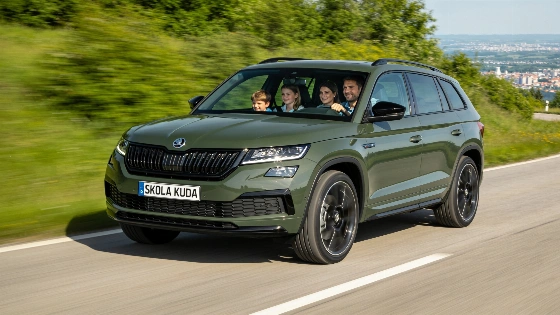
With 265 horsepower under the hood and seating for up to seven, the Skoda Kodiaq RS 2026 answers the question of what happens when family practicality meets genuine performance. Skoda’s latest flagship doesn’t shout for attention: its black grille and 20-inch wheels draw the eye, while assertive bumpers make clear this car is built for more than the school run.
Measuring 4,761 mm long and 1,864 mm wide, the Kodiaq RS commands presence without feeling unwieldy. Gloss black accents and a rear spoiler add subtle muscle, while the overall design remains unmistakably Skoda, functional and restrained. The brand has avoided over-styling, instead focusing on larger air intakes. A honeycomb lower grille hints at the car’s capabilities without sacrificing everyday usability.
Interior: Sporty Yet Sensible
Inside, the Kodiaq RS sets itself apart from the standard model with a more athletic atmosphere. High-quality materials set the tone, with red stitching on supportive perforated leather sports seats adding a premium feel without gimmicks. The 13-inch central touchscreen sits alongside a 10-inch digital instrument cluster. Wireless Apple CarPlay and Android Auto are included, while Skoda’s Smart Dials prove their worth in daily use.
Practicality remains a priority. The gear selector is mounted on the steering column, freeing up space between the front seats, a small but meaningful touch for families. Rear passengers get generous legroom and dedicated air vents, while a standard three-zone climate system helps keep the cabin comfortable. The optional third row (1,200 euros) is best suited for children or short trips with adults, as extended journeys in the back are less comfortable.
The boot is a standout feature: 845 liters with five seats in use, expanding to 2,085 liters with the rear seats folded. Even with all seven seats occupied, there’s still 340 liters of cargo space, respectable for the segment, though less impressive than in five-seat mode.
Engine and Driving: Power Without Pretense
Central to the Kodiaq RS is a 2.0 TSI turbocharged four-cylinder engine with a displacement of 1,984 cc, delivering 195 kW (265 PS) at 5,000 rpm and 400 Nm of torque from just 1,650 rpm. A seven-speed DSG dual-clutch transmission sends power to all four wheels, delivering brisk acceleration and confident overtaking. Independent tests record 0-100 km/h in 6.3 seconds and a top speed of 231 km/h, figures that put it ahead of many family SUVs. The 6.3-second sprint also improves on the approximately 6.9 seconds associated with the previous diesel RS, which used a 2.0 BiTDI producing 240 PS. The petrol engine’s 25-PS increase marks a clear shift in the RS powertrain.
Fuel consumption is a reality check: during testing, the Kodiaq RS averaged 9.5 l/100 km, with a 58-liter tank providing around 510 km of range. A German vehicle listing gives a separate combined figure of 8.5 l/100 km and CO₂ emissions of 192 g/km. Its cycle-specific figures range from 11.7 l/100 km in urban driving to 7.3 l/100 km on country roads. At 1,911 kg, it’s no lightweight, but the adaptive DCC suspension, standard on this model, smooths out rough roads and tightens up for spirited driving. DCC Plus uses a two-valve arrangement to manage compression and rebound separately. The steering and brakes favor confidence over razor-sharp response. Body roll stays well controlled, and the car feels more agile than its size suggests.
Competitors and Context
Against rivals like the Volkswagen Tayron, the Kodiaq RS matches power and concept but offers a warmer, less clinical personality. The Cupra Terramar VZ is more overtly sporty and less family-oriented, appealing to buyers who prioritize driving dynamics over space. With towing capacity of up to 2,300 kg, the Kodiaq RS adds practical versatility to its performance credentials.
Priced at 62,695 euros, the Kodiaq RS is not inexpensive, but its blend of features and capabilities is rare in the segment. As a separate European market reference, MotorBox lists the 2.0 TSI 265 CV RS DSG 4x4 at €57,800 in Italy; prices vary between countries and specifications. A recent analysis of performance vehicles, including Ducati’s edge in MotoGP (see this comparison of technical advantages in motorsport), notes how the right balance of power and usability can set a contender apart.
The RS also differs from the Kodiaq plug-in hybrid. AutoNext reports that the hybrid’s combined system output is 200 kW (272 PS), seven PS above the RS, while its 400 Nm matches the petrol model’s torque. Its powertrain pairs a 1.5-litre petrol engine with an electric motor. The battery has a 25.7 kWh gross capacity (19.7 kWh net), and DC charging reaches up to 50 kW. The RS remains the 2.0-litre, all-wheel-lead performance choice. The plug-in hybrid leads on system output and offers an electrified alternative.
Final Thoughts
The Skoda Kodiaq RS 2026 delivers performance without sacrificing the space and practicality families demand. Its price puts it at the upper end of the mainstream market, but the combination of a dynamic driving experience and family-hauling ability makes a compelling case for buyers seeking one vehicle that can do it all.
Additional context: The Kodiaq RS is one of the few non-electrified performance SUVs left in its class, appealing to drivers who still value traditional powertrains. Skoda’s focus on practical new idea, including the Smart Dials and flexible interior, continues to resonate with buyers looking for more than badge prestige. As the market shifts toward electrification, models like the Kodiaq RS may become increasingly rare, making its arrival in 2026 especially impressive.