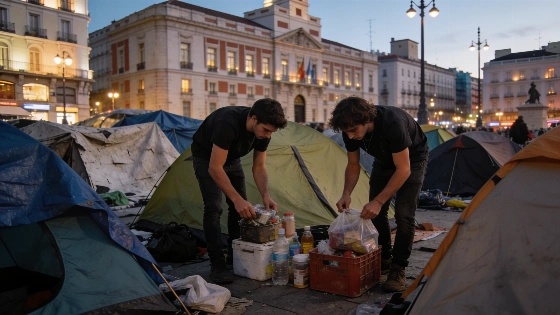
More than 2000 tents fill Puerta del Sol and spill into Arenal and Preciados. Protesters are demanding urgent housing reforms amid political uncertainty and mounting pressure from local businesses and authorities.
Puerta del Sol is now packed with more than 2000 tents, which spill into Arenal and Preciados and turn basic Madrid into a protest camp amid a housing crisis and political uncertainty. A sign asks: “Who the hell do I vote for now?”
Inside the camp, protesters are divided over what to do next. Some want to wait for unions to call a general strike; others are discussing new left-wing groups if elections are called soon. Many say they have no idea who they would vote for if a snap election were held next week.
The eviction of 87-year-old Maricarmen Abascal was the immediate trigger for the protests in Puerta del Sol, as reported by AP and ABC News. The camp’s rapid growth has caught the attention of city leaders. The Sindicato de Inquilinas de Madrid, which helped spark the protest after Abascal’s eviction, says it will reduce its visible presence in Sol. Some members are returning to their neighborhoods to prepare for a possible general strike. The group says it will stay involved as long as the camp stands. “If the encampment remains here, the union will remain,” spokesperson Valeria Racu said in a message shared on social media.
Hand-drawn messages cover the camp, with slogans that reach beyond rent: “Without a home, there is no mental health,” “People remain,” and “This is not a tourist attraction.” Taped to plastic walls, the signs call for expropriation and criticize the economic squeeze that consumes entire paychecks. Some are more unusual, including “Neither housing nor rentism. Gazpacho.” They convey protesters’ anger and exhaustion. Spain’s officials have not answered them.
Estimates of the number of tents in the Sol camp vary, with some local counts exceeding 1,200, Reuters and Euronews report. The latest nationwide mobilizations brought tens of thousands of people onto streets across Spain to demand urgent housing reforms; organizers put the figure as high as 500,000. The government of Pedro Sánchez approved emergency measures extending eviction protections for vulnerable tenants until 2030, but basic reforms failed in parliament, fueling further protests.
Legal pressure is mounting. The Tribunal Superior de Justicia de Madrid is reviewing the regional government’s push to break up the camp. The Comunidad de Madrid wants national government delegate Francisco Martín to clear the tents, while Martín’s office defends the right to protest. The dispute has pitted regional and national officials against each other.
Talk of elections hangs over the camp. Rodrigo, a young tenant paying 1,030 euros a month for a two-bedroom flat in Vicálvaro, worries about what comes next. “With elections on the horizon, this camp would be very conditioned, and our message could become politicized. It might even cause internal problems,” he says.
The camp’s size is affecting local businesses. Shopkeepers and restaurant owners in the center report sales down by 20% to 25%, blaming cancellations as well as dirt and bad smells. Some say tourists now avoid the area or hurry through its crowded streets. It is Madrid’s busiest shopping zone.
Protesters say the camp is self-run, with small groups managing different areas. The political right has seized on the disorder. José Antonio Sánchez, the PP’s territorial vice-secretary, accused the government delegate of “abandoning his duties.” He says the camp damages Madrid’s image and defends the regional government’s housing policies.
This standoff is not new. Spain’s housing crisis has prompted political disputes and street protests before, while mainstream parties have struggled to address rising rents and mass evictions.
The camp rejects old political labels, its walls filled with questions rather than answers. Unions could call a general strike, while courts could order police to clear the tents and elections could divide the movement. For now, the tents remain, a visible reminder of Madrid’s housing crisis and a test of political legitimacy.