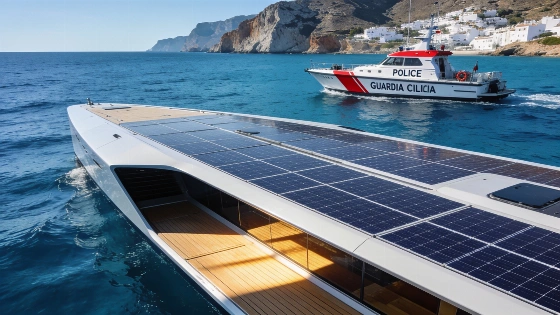
A low-profile yacht powered entirely by solar panels was stopped by Spanish authorities near Cabo de Gata after being mistaken for a narco boat. The Helios 11, built by Lukas Sjöman, had sailed over 6,000 km from Finland without refueling, highlighting the potential of sustainable maritime travel.
When the Guardia Civil intercepted a silent, low-slung vessel off the coast of Almería, officers and beachgoers alike suspected they were witnessing a drug trafficking operation. Instead, they found the Helios 11—a handmade solar yacht that had just completed more than 6,000 kilometers from Finland without a single stop for fuel.
Built over 200 days by Finnish sailor Lukas Sjöman, the Helios 11 draws all its power from the sun. Its flat, rectangular silhouette and near-silent electric propulsion led swimmers near Cabo de Gata to mistake it for a narcolancha, a type of boat often used for smuggling. The absence of a visible mast and the lack of engine noise only deepened the confusion, prompting authorities to investigate as the vessel passed through Spanish waters in July 2026.
Unusual Design Sparks Suspicion
The Helios 11’s unconventional appearance was at the heart of the misunderstanding. From shore, its broad, low profile and absence of typical sailing features made it look nothing like a traditional yacht. According to reports, some onlookers even speculated it might be a semi-submersible craft. The Guardia Civil patrol quickly determined, however, that the boat was not involved in illicit activity but was instead a pioneering example of sustainable navigation.
The yacht’s roof is covered with solar panels, and its lightweight construction—marine plywood reinforced with fiberglass—was chosen to maximize efficiency. Sjöman’s goal was to prove that a liveaboard vessel could travel long distances without relying on gasoline or diesel, a concept that has drawn growing interest as electric mobility expands into new sectors. The Helios 11’s journey included a major leg from Finland to Ibiza, covering roughly 5,700 kilometers, before continuing along the Spanish coast to Mazarrón, Cabo de Gata, and Almería.
Life On Board: Minimalist and Efficient
Measuring nearly 11 meters in length and 2.4 meters wide, the Helios 11 weighs about 1.5 tons. Its interior is compact but functional, featuring a small electric kitchen, refrigerator, and bathroom. Rather than luxury, the design prioritizes energy efficiency and the ability to live aboard for extended periods. The upper deck’s solar array generates around 6 kilowatts, feeding a 48-volt battery system that powers both the motor and essential onboard appliances.
Performance depends heavily on sunlight. On clear days, Sjöman estimates the yacht can cover up to 270 kilometers, but progress slows with cloud cover, rough seas, or shorter daylight hours. While a small auxiliary sail has occasionally provided support, the vessel’s propulsion remains entirely fuel-free. This approach echoes the broader trend toward electric travel, as seen in compact electric campers like the ARI 458 Pro Camper, which also emphasizes efficiency and minimal environmental impact (see how electric mobility is reshaping travel options).
Setbacks and Adaptation
The journey was not without setbacks. During a stop in Tarragona, Sjöman’s auxiliary dinghy was stolen—a critical loss, as the small boat was needed to reach shore when the Helios 11 was anchored offshore. Undeterred, he built a replacement and continued south, passing through Ibiza and along the Mediterranean coast. By the time the yacht reached Almería, it had logged over 6,000 kilometers, demonstrating the real-world viability of solar-powered long-distance cruising.
Context and Outlook
The Helios 11’s voyage highlights both the promise and the current limitations of solar navigation. While daily range is still dictated by weather and daylight, the project offers a glimpse into a future where extended sea travel may not require fossil fuels. As electric and solar technologies advance, such initiatives could become increasingly common along Europe’s coasts. For now, the Helios 11 stands as a rare but telling example of how innovation can challenge assumptions—even leading authorities to mistake a green pioneer for a criminal operation.