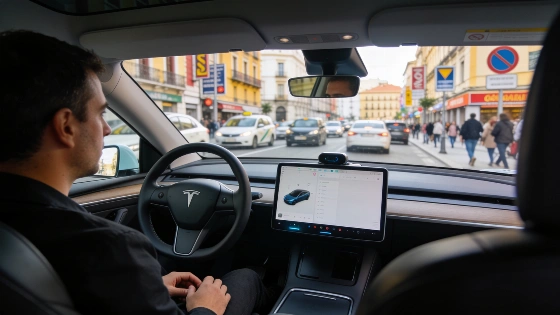
Spain has given the green light for level 4 autonomous vehicles to operate on public roads. Uber, WeRide, and AVOMO will begin a closely monitored pilot in Madrid, with each car supervised by a human operator.
Twenty autonomous vehicles are set to begin operating on Spanish streets, but none will be left entirely on their own. Spain's national traffic authority, the Dirección General de Tráfico (DGT), has issued the first license for level 4 self-driving cars to Uber, WeRide, and AVOMO. This approval, confirmed by the companies and reported by Reuters, is part of the ES-AV framework and allows for a controlled pilot program in urban areas.
The initial rollout will take place in busy parts of Greater Madrid, where demand for ride services is high and safety is a top concern. Each vehicle will have a human operator in the cabin, as required by law, to monitor the drive and step in if needed. According to EFE and Infobae, the pilot will use 20 vehicles, all under direct supervision. Regulators have not set a date for removing these supervisors, reflecting a cautious approach.
The permit allows WeRide, Uber, and AVOMO to begin mapping and validating routes, but commercial passenger service is not expected before late 2026.
Uber will handle integration of autonomous rides into its app, WeRide supplies the GXR vehicles, and AVOMO manages fleet logistics and daily operations. The first phase focuses on mapping and test runs in real-world conditions. Only after these trials, and if regulators are satisfied, will passengers be able to book rides. The companies are aiming for a public launch in late 2026, according to their joint announcement.
Level 4 autonomy means the car can drive itself and make decisions within mapped, predefined zones. Unlike level 5, which would allow a car to operate anywhere without manual controls, level 4 is limited to specific areas. This distinction sets clear boundaries for what these vehicles can do. Multiple sources, including a review of the DGT registry, note that this permit is for a pilot phase only and does not allow for immediate, widespread use of driverless cars.
With this move, Spain joins London and Zagreb as one of the few European locations where Uber is running advanced autonomous pilots. The launch comes as Spanish authorities update traffic rules and rethink urban mobility, as detailed in a recent report on new regulations.
The roles of the project partners are clearly defined: WeRide provides the autonomous technology and vehicles, Uber integrates the service into its app, and AVOMO is responsible for fleet management and operations. This marks the first joint autonomous launch in Europe for WeRide and Uber.
For now, human supervisors are required in every car. The DGT has stated that safety and public confidence will determine how quickly automation advances, not company ambitions. The companies hope that successful trials will lead to fewer restrictions, but the timeline depends on real-world results, not projections.
As reported by Google/SpainAuto, this pilot is not just a technical test—it will show whether Spain's regulations and city infrastructure can adapt to a future with fewer human drivers. The gradual approach reflects lessons from other countries, where early rollouts led to public pushback and tighter rules. If the pilot proves safe and reliable, Spain could become a model for autonomous mobility in Europe. The real challenge will come when the human supervisors step out and the technology is left to handle Spanish streets alone.