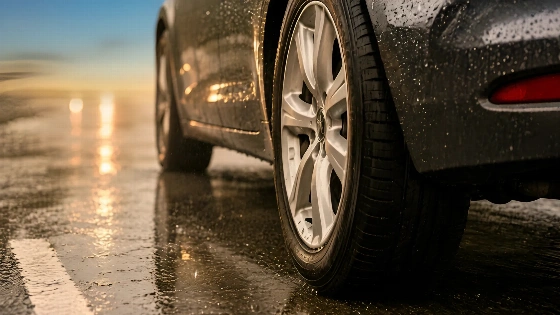
Raised wear bars at the bottom of a tyre’s main grooves show when the tread has reached Spain’s legal minimum. At that point, the tyre must be replaced before the vehicle is driven. The Dirección General de Tráfico (DGT) identifies tyres as a core safety component: they are the vehicle’s contact with the road, and their condition is essential for adhesion, braking, steering and road holding.
The Anexo VII of the Reglamento General de Vehículos, approved by Real Decreto 2822/1998, sets the minimum at 1.6 mm for passenger cars and vans. Driving below it is a serious offence, according to the DGT. The stated penalty is €200 for each tyre below the limit; if all four are worn, the total can reach €800.
The legal threshold is lower than the point at which the DGT advises changing tyres. It recommends replacement when tread depth falls below 3 mm, because shallower grooves clear water less effectively and provide less grip on wet roads. That raises the risk of aquaplaning and skidding.
Drivers can use the wear bars for a quick visual check: when the tread is level with them, the tyre has reached the minimum. They should also look for cuts, cracks, bulges or objects lodged in the rubber. Uneven wear can point to incorrect pressure; faults in alignment or suspension are also possible. European tyre labels provide information on fuel consumption, safety and external rolling noise, but they do not replace checks of tread depth, damage or compatibility.
DGT material reports that, in an audit involving more than 700 assessments, 30% of vehicles had tyres in poor condition and 12% had problems with their braking system. This describes general condition, not the proportion of tyres below the 1.6 mm legal limit. Separately, Spanish ITV stations inspected more than 19.5 million vehicles in 2019 and rejected more than 4 million, around one in five, for defects across the overall roadworthiness inspection, not tyres alone.
The DGT advises checking tyre pressure at least once a month when the tyres are cold, and before a long journey. This roadworthiness rule is separate from Madrid’s planned 2027 withdrawal of a 10% regulated-parking discount for C-label cars, covered in this parking report.