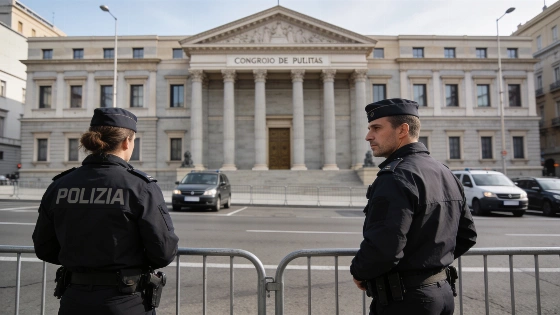
Up to 600 riot police will guard Spain's Congress on Friday as lawmakers vote on two housing decrees. The deployment comes amid the possibility of protests linked to the Puerta del Sol camp.
Up to 600 officers are due to guard Spain's Congress during an extraordinary plenary session on Friday, 2 October. Lawmakers will vote separately on two royal housing decrees approved by the Council of Ministers on 30 September and published in the BOE. Both still require ratification by Congress.
The government kept both texts before the vote, despite Junts' request to withdraw one. Their approval depends on the balance in the lower house.
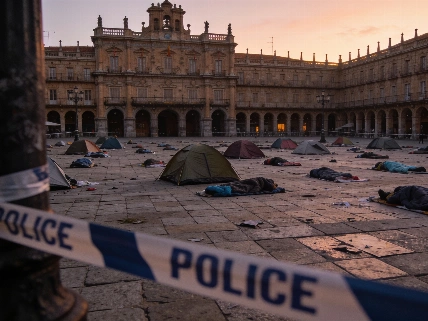
Police expect people from the Puerta del Sol camp could move towards Congress during the session, although no protest has been confirmed.
The planned force includes up to 600 officers. Most will come from the Unidades de Intervención Policial, known as the UIP, with support from the Comisaría General de Información.
Officers will monitor the area around the Congreso de los Diputados and prepare for a possible attempt to surround the building or for disturbances during parliamentary activity. The initial deployment is preventive.
Wider street closures remain possible if conditions change.
Traffic in central Madrid will be affected. Vehicle movement will be restricted on streets leading to Congress, while Calle Zorrilla will remain under police control. Reports on the planned operation say restrictions could start at 10.00 hours and cover the approaches to Parliament.
Deputies will use a separate route. Cars and motorcycles can approach from the Paseo del Prado or Calle Marqués de Cubas via Alcalá, then continue towards Zorrilla, the designated entrance to the Congress car park.
The parking entrance at Plaza de las Cortes will be closed. Authorised vehicles must use the Zorrilla route. The initial exit plan sends them through Carrera de San Jerónimo, then along Calle del Prado and San Agustín.
Those routes may change, and police commanders can impose further restrictions.
The first decree concerns the "protección de la función social de la vivienda y la ampliación de la oferta de vivienda asequible". It still has a chance of passing through the lower house. The second text covers the automatic renewal of rental contracts.
An earlier report described a possible movement from Sol towards Congress. The new operational details show how far the response may reach: police control will cover the building and nearby streets, including routes used by parliamentary vehicles.
The camp in Puerta del Sol has continued for several days. Protesters have called for action on rents and evictions, while reports say housing protests have spread beyond Madrid. That pressure has kept the issue in front of the government and Parliament.
For people crossing central Madrid, the immediate result will be a controlled road network around Congress. Officers will be ready to respond without treating a protest as a confirmed event.
The planned force is reported at 500 to 600 officers. It reflects a possible scenario, not proof that anyone will try to surround the chamber. Congress is preparing for the risk while parliamentary access remains open.