Sánchez Uses Hantavirus Crisis to Showcase Effectiveness of Cooperation with WHO. Pedro Sánchez has publicly highlighted the benefits of supporting the WHO and UN following the hantavirus incident. The Prime Minister contrasted Spain’s policy with those of Trump and VOX. Authorities emphasize the importance of international solidarity.
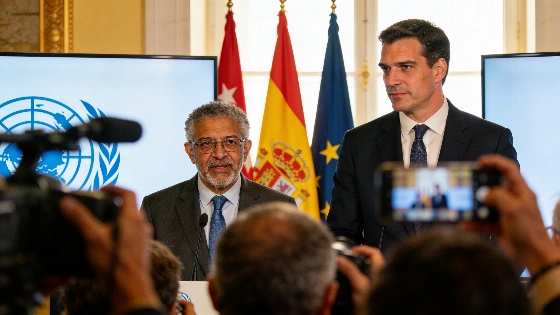
Pedro Sánchez opted for a public reaffirmation of Spain's commitment to cooperation with international organizations following the resolution of the hantavirus-related crisis. At the concluding press conference with the head of the World Health Organization, Tedros Adhanom, the president emphasized that Spain acts not out of fear but out of solidarity—something he believes distinguishes the country from those choosing isolation and nationalism.
The room where the meeting was held featured screens displaying the slogan "España cumple" and the logos of the government and WHO—a visual focus that was deliberately chosen. Sánchez and his team aimed to highlight that the success in overcoming the crisis was possible not only due to the standard of Spanish healthcare but also thanks to consistent support for multilateral institutions such as the UN and WHO. Against this backdrop, the president recalled Argentina's decision to leave the WHO—a step initiated by President Javier Milei, following the example of Donald Trump. These are the very political forces Sánchez engages with ideologically, underscoring the contrast between Spain's approach and the position of VOX, whose representatives have recently called the WHO an "agent of globalism."
Contrast with the opposition
Throughout the crisis, Sánchez avoided open conflicts with regional authorities, particularly with the president of the Canary Islands, Fernando Clavijo. Even at the final press conference, he refrained from commenting on the controversial statements about 'floating mice,' which had affected the image of the Canarian leader. Instead, the president emphasized Spain's international responsibility and cited a specific example: this summer, 6 million Spaniards will travel abroad, and each of them can count on protection and support similar to that received by the 150 people caught in the hantavirus outbreak.
Sánchez noted that Spain not only receives help when necessary, but is also ready to support other countries. According to him, this approach strengthens trust in the country on the international stage and shapes a positive image of Spain as a state that adheres to international norms and rules. The WHO chief, in turn, praised the actions of the Spanish authorities and specifically highlighted the contribution of the residents of the Canary Islands, calling them an example for other countries.
International context
In the context of the election campaign in Andalusia, where the ruling party's position remains weak, Sánchez is using the hantavirus issue to strengthen trust in his leadership. He contrasts a strategy of cooperation with international institutions against the politics of fear and isolation—which, in his view, are promoted by Trump, VOX, and segments of the European right. The president emphasizes that Spain is not a country of chaos but a state capable of responding effectively to crises and demonstrating solidarity.
In this context, it is telling that even the opposition has reduced the intensity of its criticism and shifted the focus of its campaign rhetoric. Sánchez is confident that the hantavirus situation will serve as a model for future decisions and will not be quickly forgotten. He calls for pride in a country that fulfills its obligations to citizens and the international community, insisting that only through science, cooperation, and adherence to international rules is it possible to build a safer world.
Background and context
The issue of political confrontation around international institutions and Spain's role in global affairs has already been raised in other regions of the country. For example, in Andalusia, on the eve of elections, the conflict over the principle of regional equality and methods of governance has intensified, as detailed in the article on the strategies of regional leaders. This highlights that issues of international cooperation and domestic policy remain at the center of public attention.