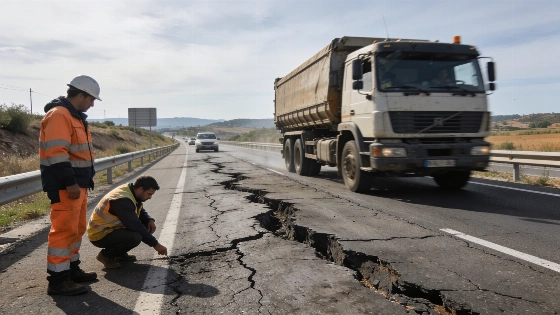
More than 34,000 kilometers of Spanish roads require urgent rebuilding after years of underfunding. Heavy truck traffic is accelerating deep ruts and cracks, while the government’s new plan aims to address a €13.5 billion maintenance shortfall.
Deep ruts and cracks are reappearing across Spain’s highways just as the summer travel season peaks. According to the Asociación Española de la Carretera (AEC), over 34,000 kilometers of roads now need urgent reconstruction after years of insufficient maintenance, with the cost of restoring the national and regional networks estimated at €13.491 billion.
The Ministry of Transport presented its Extraordinary Pavement Improvement Plan to regional governments on July 28, 2026, aiming to tackle the most critical sections. The latest AEC audit found that 52% of the evaluated network suffers from severe or very severe deterioration, and nearly a third must be rebuilt within a year to prevent further decline.
While heavy trucks are often blamed for the rapid wear, the real issue is more complex. The damage depends not just on total vehicle weight, but on how that weight is distributed across axles and how frequently the same spot is stressed. Technical studies, including the well-known fourth power law, show that doubling axle load can multiply pavement fatigue by up to sixteen times. However, the actual impact varies with pavement type, thickness, and existing condition. Spreading weight over more axles reduces the strain, and modern road design is supposed to account for heavy vehicles as a normal part of traffic.
Major routes like the A-6, A-3, and A-67 are cited as examples where deep ruts, cracks, and potholes have forced drivers to shift lanes to avoid the worst sections. These deformations are most pronounced in the right lanes, where trucks concentrate. The consequences go beyond discomfort: repeated impacts from potholes can damage shock absorbers, tires, and even electronic systems, leading to costly repairs that drivers may not immediately link to road conditions.
Billions Needed for Recovery
The €13.491 billion figure from the AEC is not an annual budget, but the total investment required to restore both state and regional roads to acceptable standards. Of the 101,700 kilometers assessed, nearly 34,000 need intervention within a year, and another 20,000 show serious damage that should be addressed within four years. The Ministry’s own estimate, focused only on the State Road Network, puts the backlog at €5.6 billion for its 26,500 kilometers—just 16% of Spain’s roads, but carrying over half of all traffic and two-thirds of heavy vehicles. The government plans to invest €1.629 billion between 2027 and 2031, starting with 5,000 kilometers, with tenders launching later this year.
Why Ruts Form—and Where
Ruts are long depressions that trace the path of wheels, forming as pavement layers deform under repeated heavy loads. They are especially common where intense truck traffic meets poor maintenance. Some drivers now avoid the worst-affected right lanes, shifting to the center or left, but the problem is highly localized and not uniform across entire highways. The damage is not just cosmetic: it can trigger vibrations, uneven tire wear, and mechanical failures, as mechanics warn.
Surface Repairs Aren’t Enough
Recent works on the A-5 near Madrid highlight why simply resurfacing is not a lasting fix. The Ministry awarded €15.4 million to rebuild the pavement between kilometers 10 and 36.7, including deep repairs to the sub-base and upper layers, with lane closures and narrowings scheduled through July and August 2026. Officials acknowledge that while annual investment in the state network has reached €1.8 billion, years of underfunding have left a backlog that now requires much more expensive interventions.
The new government plan aims to shift from reactive patching to preventive maintenance, but its first phase will not begin until 2027. In the meantime, drivers must navigate deteriorating roads, and the logistics sector continues to rely on highways that are increasingly showing their age.
For motorists, the state of the roads is not just a matter of comfort but of safety and cost. As highlighted in a recent analysis of driving risks, even seemingly minor factors—like footwear—can have legal and financial consequences, as explained in this guide to summer driving rules in Spain.
Spain’s road crisis is now impossible to ignore. With billions needed and repairs lagging behind, the challenge for authorities is not just to catch up, but to prevent the next wave of costly damage before it arrives.