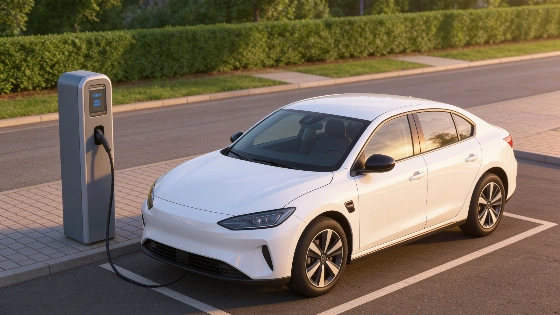
Spanish residents looking to switch to electric or plug-in hybrid vehicles can apply for financial support under the Auto+ program. Administered by Spain’s Ministry of Industry and Tourism, the scheme sets a national structure for vehicle incentives. Its rules are set out in Royal Decree 609/2026, dated July 22 and published in the Boletín Oficial del Estado on July 23. The current call for individual applicants is scheduled to close at 14:00 on December 31, 2026, although applications are processed in submission order and funding may run out before the deadline.
Grants are retroactive to January 1, 2026, allowing buyers who have already purchased qualifying electrified vehicles to apply if they meet the program’s requirements. Eligible powertrains include battery-electric and hydrogen, as well as extended-range electric and plug-in hybrid vehicles, subject to technical, price and other conditions. Both new cars and nearly new vehicles, registered within the past twelve months, qualify under the scheme’s rules. Auto+ is designed to run through annual calls and is scheduled to continue through December 31, 2030.
Individual applicants must be over 18, legally resident in Spain, and up to date with their tax and social security obligations. Applications are submitted online through the official government portal. Applicants must upload a detailed purchase invoice and vehicle registration from the Dirección General de Tráfico. They must also provide the ITV inspection card and a bank certificate confirming account ownership for payment.
The private-buyer line, Línea 1, has a budget of €350 million. Eligible applicants can receive up to €4,500 for an M1 passenger car and €5,000 for a light N1 van. The grant is €1,100 for an electric motorcycle in categories L3e, L4e or L5e, and €1,500 for an L6e or L7e quadricycle. Passenger cars priced above €45,000 before tax are excluded; those priced between €35,000 and €45,000 qualify for reduced support. Eligible cars and vans require a dealer discount of at least €1,000.
The final passenger-car grant depends on the vehicle’s price and manufacturing criteria. The car must also qualify under the program’s “Lista Blanca.” For cars priced up to €35,000 before VAT, the reported base grant is €3,375; for cars priced between €35,000 and €45,000, it is €2,925. European Union assembly can add €675, while EU battery assembly can add €450, bringing the maximum to €4,500. The model must appear on the list on the date of application to qualify.
Demand has already accounted for a large share of the private allocation. By mid-October, applicants had requested €258.77 million, leaving approximately €91.23 million of the €350 million budget. The reported average private application was about €3,167, below the maximum passenger-car grant. Madrid accounted for almost one in four requests in the regional distribution reported by El Correo. Applications are submitted electronically and processed in order, so the formal December closing date does not guarantee that funds will remain available until then.
Auto+ consolidates support once spread across fragmented schemes, tying grant levels to affordability and European manufacturing. Buyers and dealers have long complained about slow disbursement. As highlighted in a recent report on early technical challenges, demand for the grants is high. The unified system is intended to ease bottlenecks that affected earlier incentive programs.
A separate €50 million business line, Línea 2, covers self-employed workers and companies. Its application window opened on October 1, 2026, and is due to close at 14:00 on December 31. The line supports purchases and rental or leasing contracts, which must last at least three years under the program guidance. This separate allocation distinguishes business applicants from Línea 1, intended for adult residents who do not conduct an economic activity.
Spain’s Auto+ program is designed to support the shift to cleaner vehicles through a national mechanism. Assistance varies by vehicle price and production characteristics, with different amounts for eligible models. The Ministry’s published funding figures show strong private-buyer demand, while the fixed allocation leaves applicants facing the risk that funds could run out before the call formally closes. The automotive sector is also watching for continuity of support after the current call ends.