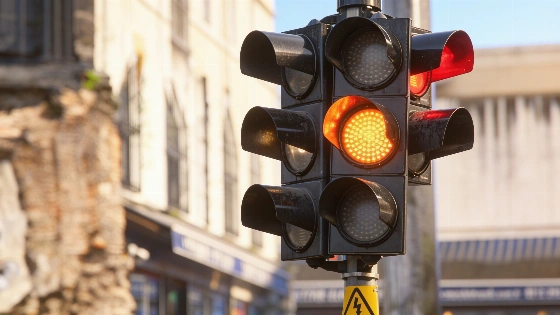
Starting in October, Spanish drivers will face tougher penalties as the DGT removes the ambiguous amber phase at pedestrian crossings. The new law requires a red light for vehicles whenever pedestrians have green, ending decades of risky overlap.
Crossing the street in Spain is about to change. From 1 October, the Dirección General de Tráfico (DGT) will enforce new rules for traffic lights at pedestrian crossings, ending a system that has caused confusion and close calls for years in Spanish cities.
Until now, intersections often put pedestrians and drivers in a risky situation: pedestrians would see a green light to cross, while drivers faced a flashing amber, meaning they could go if the crosswalk was clear. Both sides had to guess what the other would do, leading to sudden stops, hesitation, and sometimes accidents. Reports from Democrata and El Español have pointed to this overlap as a persistent safety problem, prompting the DGT to act.
The Real Decreto 518/2026, published on 24 June 2026, officially mandates that from 1 October 2026, vehicles must face a solid red whenever pedestrians have a green signal at regulated crossings.
The new regulation removes any doubt. When the pedestrian signal turns green, vehicles will now see a solid red—no more flashing amber, and no room for interpretation. If people are crossing, cars must stop. The DGT wants to make pedestrian priority clear and reduce confusion and sudden braking at intersections. Russpain notes that this reform is a direct response to urban safety concerns.
Cities across Spain are updating their traffic lights to comply. Municipal engineers are reprogramming signal cycles so that the new red phase for vehicles matches the pedestrian green. This is a technical challenge for many intersections that previously only used green and flashing amber for cars. Now, a fixed red must appear before any amber phase. According to technical summaries cited by TravelGumbo, municipalities must ensure that the red phase for vehicles always comes before any amber at crossings with pedestrian signals.
The flashing amber light is not disappearing everywhere. The DGT says it will still be used at intersections where there is no direct pedestrian conflict, as a warning for drivers to proceed with caution and follow any other road markings or signs.
The flashing amber phase will continue to be used at intersections and locations where there is no direct conflict with pedestrian crossings, maintaining its role as a cautionary signal for drivers in non-pedestrian scenarios. (OKDiario)
Drivers who ignore the new rules and run the red at a pedestrian crossing will face the same penalties as running any red light: a €200 fine and a deduction of four points from their license. The DGT has made it clear that confusion or personal judgment is no longer an excuse.
This change is part of a wider effort to improve road safety in Spain, especially for pedestrians, cyclists, and users of personal mobility vehicles. The updated regulations also include new measures for electric scooters and motorcycles, reflecting changes in urban transport.
As the new system comes into force, drivers will have to adjust quickly. The DGT hopes that removing the grey area at crossings will make streets calmer and more predictable—and, most importantly, safer. The real test will be whether drivers and local authorities follow through with the discipline the law now demands.