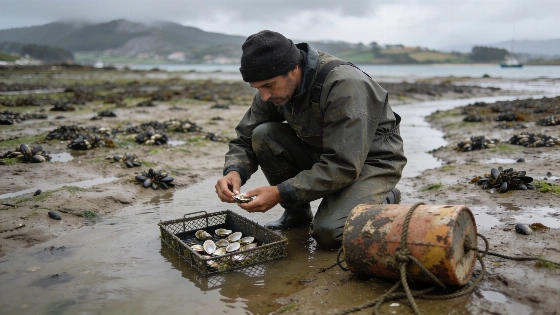
The OECD expects Spain's economy to grow by 2.6% in 2026, but prices could rise faster than household incomes. In Galicia, shellfish sales have fallen sharply as pollution, lower salinity and climate change cut production.
Spain may grow faster in 2026 while many households become poorer in real terms. The OECD forecasts 2.6% economic growth. It expects prices to rise by 3.7% this year and 3.4% next year. That turns a positive headline into a direct test of what people can afford. The organisation also expects growth to slow to 1.8% in 2027. The current expansion may not last at the same pace.
Santiago Niño Becerra made that distinction on La Ventana. His assessment is blunt: a higher gross domestic product does not guarantee better living standards for most people. The gains may instead go to companies and people with legal tax tools that help them absorb inflation.
The OECD raised its estimate of Spain's core inflation to 3.4% for 2026. That points to a risk of persistent price pressure, not only a temporary shock caused by energy costs.
Employees have fewer ways to protect their incomes. Independent forecasts also put Spain's 2026 inflation rate above the expected eurozone average of about 3.0%. That raises the risk that higher prices will weaken household demand even as the economy expands. Funcas has previously warned that inflation could stay high in the coming months, putting average inflation for 2026 at about 3.6%.
The pressure is visible beyond household budgets. Galicia's shellfish sector has gone through several campaigns with low profits. It sold 3,742 tonnes in 2025. In 2015, the volume was more than twice as high, according to data presented in the programme. More precise official figures cited in independent reporting put the 2025 volume of fresh bivalve shellfish sold through Galician fish markets at 3,742,212 kilograms, compared with 7,776,585 kilograms in 2015.
The decline in Galicia's shellfish trade amounts to 51.9% between 2015 and 2025. The length of the decline indicates a structural problem affecting coastal communities and related employment, rather than a single poor season.
The decline has been linked to lower salinity, pollution and climate change. This is not only a problem for one coastal activity. For Niño Becerra, it shows the weakness of an economic model that keeps tying expansion to environmental damage.
The economist pointed to studies showing a link between carbon dioxide emissions and gross domestic product. That does not mean every increase in GDP automatically produces the same environmental result. It does put the current growth model under pressure. Cutting pollution would require major investment in cleaner technologies, and the material identifies no viable alternative capable of reducing contamination drastically.
The figures connect two problems that are often reported separately. Inflation reduces what salaries can buy. Environmental damage is shrinking a productive sector in Galicia. The OECD's projection has already been reported in an earlier forecast, but the sharper question is what kind of growth reaches households and lasts in regions that depend on natural resources. The OECD's revised inflation outlook has also been linked to renewed energy risks. Those risks can push up consumer prices and further cut real incomes.
That is why the 2.6% figure cannot stand alone. Growth alongside 3.7% inflation offers limited protection to wage earners. The fall from more than twice the 2025 shellfish volume in 2015 also shows the cost of an economy tied to polluted and changing environments. The evidence points to a clear conclusion: Spain cannot measure success through GDP alone when purchasing power is falling and a traditional Galician sector is shrinking under environmental pressure. A separate S&P estimate is more cautious, putting Spain's 2026 growth at 2.4% and inflation at 3.2%. It points to the same tension between expansion and the cost of living.