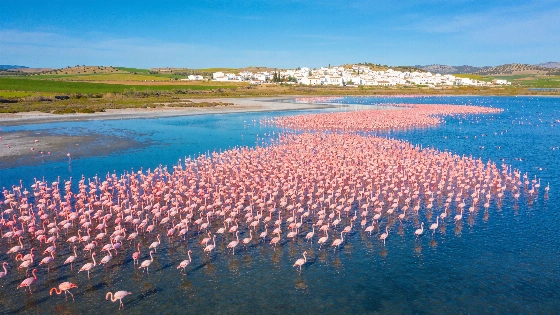
Each spring, thousands of flamingos change Fuente de Piedra Lagoon in northern Málaga into one of Europe’s most impressive wildlife spectacles. Doñana and the Ebro Delta often dominate conversations about Spanish wetlands, but this lesser-known site hosts Spain’s largest flamingo breeding colony and ranks among Europe’s most impressive sites for the species.
Near Antequera, the shallow, saline lagoon covers almost 1,500 hectares and stretches roughly seven kilometres at its widest point. It is Andalusia’s largest inland wetland and a designated Natural Reserve within the EU’s Natura 2000 network. It also has ZEPA and ZEC protections, along with Ramsar status. Its waters, shaped by rainfall and underground aquifers, have supported wildlife and human activity for centuries. Salt was harvested here from Roman times until the 1950s.
Flamingos in Their Thousands
The basic draw is the greater flamingo. The Junta de Andalucía says Fuente de Piedra Lagoon can host up to 20,000 breeding pairs in favorable years, making it a major European stronghold for the species. The birds gather especially around La Colonia, the breeding island, where reproduction takes place in spring and summer. Spring is the best time to see them, particularly at dawn, when the birds are most active.
Conditions change outside the breeding season. The basic lagoon can become almost completely dry, while the smaller Laguneto tends to hold water more reliably. In autumn, the lagoon begins to refill after the summer, but many flamingos have dispersed. Visitors hoping to see the breeding colony should plan for spring.
Birdwatching Made Accessible
Fuente de Piedra is home to more than flamingos. Over 170 bird species have been recorded in the area, including the white-headed duck. Grey herons and slender-billed gulls are also among them. Other waterbirds and waders around the wetland include black-winged stilts and avocets, along with green sandpipers, marbled ducks, pochards and shovelers. The Laguneto can offer rewarding birdwatching even when the basic lagoon holds little water.
Marked trails and viewing platforms help visitors watch wildlife while limiting disturbance; bird hides offer another vantage point. The Sendero de las Albinas is a roughly six-kilometre, level route linking the visitor centre with Cerro del Palo viewpoint and the Vicaría observation area. The shorter Laguneto trail starts at the José Antonio Valverde Visitor Centre, runs for just 353 metres and takes about 10 minutes to walk. The centre also has adapted facilities for wheelchair users, information from TUR4all’s accessibility information.
Exploring the Surroundings
Beyond the lagoon, the nearby village of Fuente de Piedra invites visitors to explore its whitewashed streets and sample local cuisine. The historic Plaza de la Constitución and the Palacio de la Marquesa reflect the area’s cultural heritage. Animal lovers can visit El Refugio del Burrito, a village sanctuary for donkeys and mules. Those extending their trip can also reach the dramatic Torcal de Antequera and the famous Caminito del Rey in the Gaitanes Gorge.
Fuente de Piedra Lagoon reflects Andalusia’s rich biodiversity and the appeal of its wild spaces. For birdwatchers and travelers looking beyond Spain’s best-known reserves, this corner of Málaga offers a rare experience that changes with the seasons.