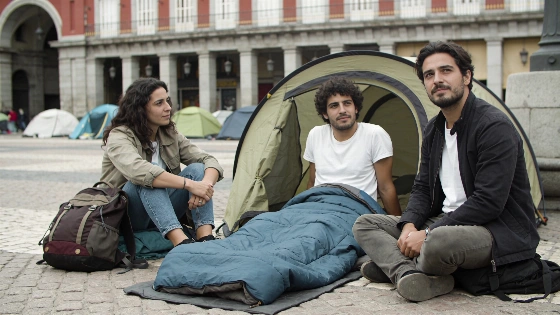
Hundreds are camping in Madrid's Puerta del Sol as mortgage activity falls. The average loan has reached a record 180,785 euros, while fewer buyers are completing purchases.
Spain's banks registered 43,372 home mortgages in July 2026. That was 3.5% fewer than a year earlier and 5.5% fewer than in June.
The average mortgage rose to 180,785 euros, an increase of 10.9% from a year earlier. The figure is a record in this data series and is close to 181,000 euros.
That is the squeeze.
The fall in mortgage registrations was the sharpest since June 2024, according to Spain's National Statistics Institute, known as INE. At the same time, each completed purchase required more borrowed money.
INE also recorded 61,417 home sales in July 2026, down 5.1% from a year earlier, adding evidence that activity across the housing market was cooling alongside mortgage lending.
Home sales are weakening too. INE recorded 61,417 property transactions in July, down 5.1% from a year earlier.
For buyers, the pressure has not eased.
Robin Decaux of Equito describes a market with fewer operations but no similar drop in financing volume. Each deal now needs more capital. That can shut out people trying to buy their first home.
Yogi Thadhani, who leads Finteca in Spain, points to the shortage of homes for sale. He says that shortage is pushing prices higher.
More than 62% of buyers are choosing fixed-rate mortgages. Ricardo Gulias, chief executive of RN Tu Solución Hipotecaria, also sees buyers who remain active and banks that continue to grant credit. His view is that high prices are forcing purchasers to take on more debt for the same type of property.
The monthly comparison was also negative: the 43,372 mortgages registered in July were 5.5% fewer than in June. The combination of a year-on-year decline and a weaker monthly result points to a slowdown rather than a complete collapse of lending activity.
Credit has not disappeared.
Ricard Garriga, co-founder and chief executive of Trioteca, describes demand as solid. He points to two factors that could slow the market over time: the recent rise in Euribor and an expected increase in the cost of fixed-rate mortgages.
The July figures show why financing costs matter. The average interest rate on mortgages secured against homes was 3.01%. The average term was 26 years.
Variable-rate loans made up 37.7% of new mortgages. Fixed-rate agreements accounted for 62.3%.
The average starting rate was 2.97% for variable mortgages and 3.03% for fixed ones. Fixed financing led the market despite its slightly higher initial rate.
iAhorro reported the same rate structure. The Banco de España continues to publish Euribor and other reference-rate data in its monthly mortgage statistics.
Existing mortgage terms were changed less often in July. The total number of mortgages with altered conditions recorded in property registers fell 18.6% year on year.
Novations with the same lender dropped 19.3%. Debtor subrogations fell 19.6%, while creditor subrogations declined 3.8%.
Interest rates accounted for 82.0% of the 10,926 mortgages whose conditions changed. For borrowers, the main issue is the cost of credit. The data do not point to a broad wave of ownership or lender changes.
The regional picture is uneven.
The Balearic Islands recorded the largest annual increase in home mortgages at 8.6%. Asturias followed at 8.1% and Galicia at 7.1%.
The sharpest falls came in Cantabria, where mortgages dropped 26.9%. Aragon followed with a 20.5% decline, while La Rioja fell 19.7%.
The market has not frozen. Credit is still available, and demand remains present.
Yet the average amount needed for a purchase keeps rising. Fewer mortgages are being signed, and the loans behind completed deals are larger. That puts the strain on household borrowing capacity.
The figures support the concern raised by protesters in Madrid. Access to housing is restricted by the shortage of homes for sale and by the size of the debt needed to buy one.
Idealista News described the figures as consistent with cooling activity amid expensive financing and high housing prices.