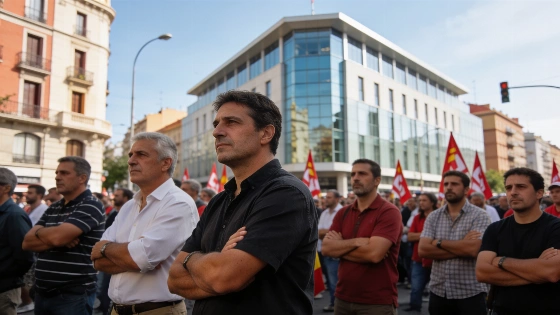
UGT and CCOO will stage a 24-hour strike on 11 November 2026, weeks before Spain votes. The dispute reaches from housing costs to wages and now tests the government’s legal and political footing.
Parliament was dissolved on the same day the unions fixed 11 November 2026 for a 24-hour nationwide stoppage. Spain will hold early parliamentary elections on 29 November, putting the strike inside the campaign period.
Pedro Sánchez had appeared to occupy a position no other democratic president in Spain had held: his government had not faced a general strike. José Luis Rodríguez Zapatero did face one after extending the contribution period required to qualify for a public pension. That distinction is now outdated. UGT and CCOO have set the date, turning the conduct of the major unions into a central part of the political story.
The strike scheduled for 11 November 2026 is the first nationwide general strike faced by Pedro Sánchez’s government, according to the updated reporting on the mobilisation.
The immediate dispute began with rejected housing decrees. The unions have framed the action more broadly, pointing to unaffordable housing and weak wage growth. They also demand a response to the continuing loss of purchasing power.
Employers read the timing as an intervention during the election campaign rather than a conventional labour dispute. The Government’s backing for the protest strengthened that interpretation.
CCOO and UGT are using a nationwide stoppage to demand that employment income cover housing costs. They also want pressure to continue through collective bargaining.
CC.OO. is portrayed in the source material as operating close to Sumar, while UGT is presented as aligned with the PSOE. The earlier model placed autonomous and independent unions between governments and parties. Those organisations focused on workers’ interests regardless of ideology. They also claimed independence from religion or personal belief.
The progressive coalition government changed that balance. Union strategy became a direct factor in its political stability.
According to the account attributed to CEOE, second deputy prime minister and labour minister Yolanda Díaz often acted more like a union leader than a cabinet member. The main social advances of the past eight years came primarily through the BOE. Employers and unions did not achieve them through sustained bargaining inside companies.
The minimum wage rose by 67 percent. Pensions increased. The proposed reduction of working hours also came from the Government rather than collective bargaining. It failed after Junts and PNV withheld support.
The legal status of the stoppage is not decided through an automatic administrative approval or ban. Its legality depends on the organisers’ right to call it, compliance with notice requirements, essential-services rules and limits established by Spain’s Constitutional Court.
The main exception was the agreement between employers and unions on labour reform aimed at reducing temporary work. According to the source material, Yolanda Díaz’s political use of that agreement ended the period of social concertation.
Antonio Garamendi has repeatedly argued that union action served the creation of Sumar and Pedro Sánchez’s electoral interests.
The cost of that arrangement appears in household finances. Despite an expansionary cycle in the Spanish economy, the living standard of the working middle class did not improve after inflation and taxes were counted.
The unions also carry responsibility. They lead collective bargaining, yet did not protest against the absence of tax deflation. They did not mobilise against the sharp rise in house prices and rents or limited investment in housing.
The new mobilisation includes specific wage demands. Union proposals for a new agreement on employment and collective bargaining call for pay rises of between 4 and 7 percent. They also seek mechanisms to adjust wages if inflation accelerates.
AFP and other reports describe a demand that salaries keep pace with the cost of housing. That framing makes the strike broader than a protest over the two rejected decrees.
Housing exposed the same weakness. No comparable mobilisation took place over the 272,000 evictions recorded during these eight years until the case involving Maricarmen.
The current housing agenda reaches further. Unions and housing organisations have called for a social pact on housing and limits on rents. They also want a permanent social-housing fund, along with full implementation of Spain’s right-to-housing law across the country. An earlier report examined the wider political setting.
Pedro Gil, a former senior UGT official during Nicolás Redondo’s leadership, argues that union finances depend more on public resources than on membership dues. Those dues declined during the period described. His claim offers a direct explanation for why preserving administrative concessions may have become more important than confronting the Government.
The employers’ response has sharpened the legal dispute. CEOE and Cepyme have argued that the strike goes beyond an ordinary labour conflict and questioned whether it fits the legal framework.
Antonio Garamendi has described the action as political. Sánchez, by contrast, said the Government would respect the constitutional right to strike. He argued that access to housing affects many workers and their families.
Reuters reported the decision as part of a confrontation unfolding alongside the early-election timetable.
Support may extend beyond Spain’s two largest unions. Reports cited Galicia’s CIG. They also described backing or participation from the Basque unions ELA and LAB.
That wider support would give the action a broader territorial base. Its scale and economic impact will depend on participation and on the essential-services arrangements established for the day.
The legal position does not turn on an automatic administrative approval or ban. It depends on whether the organisers have the right to call the strike and whether they meet the notice requirements. Essential-services rules and limits set by Spain’s Constitutional Court also apply.
On 11 November 2026, the stoppage will take place 18 days before the 29 November elections.