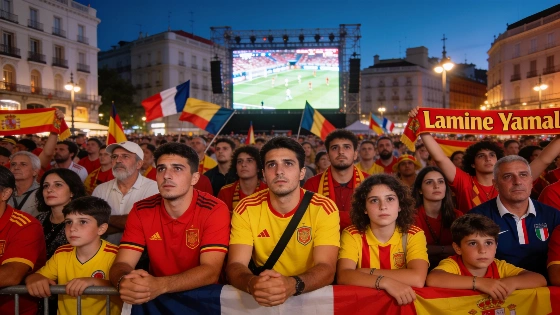
Spain’s return to the World Cup semifinals after a 16-year absence stirred anticipation across the country. From early morning, fans filled city squares and basic streets to follow the national team’s push for a second star. The semifinal against France was played in Arlington, Texas, but its stakes resonated across Spain, where public gatherings made the match a national event.
In Mataró, Lamine Yamal drew the spotlight. His rise has become a point of pride, especially in the Rocafonda neighborhood. The 19-year-old Barcelona winger had already been basic to Spain’s campaign; his earlier performance against France at UEFA Euro 2024, where he scored at 16, made him a familiar figure in the rivalry. Residents followed each development closely, with banners and flags on display as people gathered around screens.
Along the Costa Brava, the mood was just as intense, with rivalry adding another edge. French tourists brought friendly competition to cafes and promenades as local supporters and visiting fans watched their teams meet again in a major tournament semifinal. Spain had beaten France 2-1 in the Euro 2024 semifinal, then defeated England in the final, giving the latest encounter a recent competitive history.
The match in Arlington ended 2-0 to Spain. Around the 20th minute, with the score still goalless, Yamal’s pressing led France defender Lucas Digne into a challenge that resulted in a penalty. Mikel Oyarzabal converted from the spot, and the decision stood after a video assistant referee review. Spain advanced to the final and went on to win the 2026 World Cup, extending a run of major success after its 2024 European Championship victory.
The match became a social phenomenon, bringing together people from different regions and backgrounds. The scale of public viewing events recalled earlier high-stakes encounters, including recent Spain-France tensions after political remarks made headlines ahead of a major game. The diplomatic fallout described in this report on pre-match controversies shows how football can amplify national sentiment and cross-border rivalries.
Spain’s World Cup journey has long united the country, and the 2010 victory remains fresh in collective memory. The 2026 campaign revived that spirit as fans gathered in plazas from Madrid to Barcelona and beyond. Local authorities coordinated with police and emergency services for large gatherings, while young talents such as Yamal became a focus for supporters across generations. The semifinal’s decisive moments, followed by Spain’s eventual title, highlighted football’s enduring place in Spanish public life.