Ahead of the total solar eclipse on August 12, 2026, ONCE and the Ministry of Science will provide two million certified solar viewing glasses across Spain. Distribution will take place through ONCE vendors and major science centers, ensuring public safety during the rare astronomical event.
Two million certified solar viewing glasses will be handed out for free across Spain in preparation for the total solar eclipse on August 12, 2026. The initiative, led by the Ministry of Science, Innovation and Universities in partnership with Grupo Social ONCE, aims to ensure safe public observation of the rare astronomical event.
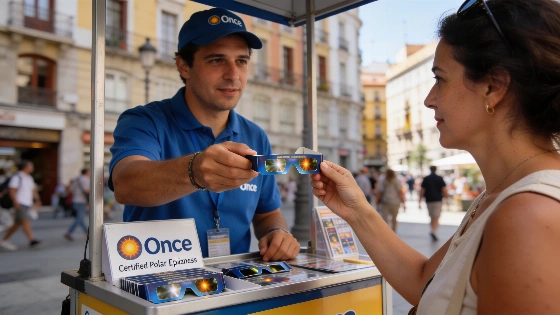
Under the campaign «Una vista única. Cuídala», ONCE will distribute 1.7 million glasses through its extensive network of street vendors and kiosks. The remaining 300,000 units will be managed by the Spanish Foundation for Science and Technology (FECYT), reaching the public via museums, science centers, and other educational institutions. The agreement was formalized at the National Museum of Science and Technology (MUNCYT) in A Coruña.
How to Get the Glasses
From the week starting August 3, ONCE vendors will begin distributing the certified glasses at all their regular sales points, including kiosks and mobile locations. No purchase is required, though the glasses will be available alongside special eclipse-themed lottery coupons. There is no national reservation system or online form; distribution is strictly in-person and subject to availability at each location.
Science Centers and Museums
The FECYT will allocate 300,000 glasses to a network of science museums and centers throughout Spain. Participating venues include the Museo Interactivo de la Música de Málaga, Parque de las Ciencias de Andalucía in Granada, Museo Aragonés de Paleontología in Teruel, Bioparc Acuario de Gijón, Museo de la Ciencia y el Cosmos in Tenerife, Museo Elder in Las Palmas, and many others across all regions. The exact dates, times, and quantities for each center have not been specified, so visitors are advised to check official channels before traveling.
Ensuring Glasses Meet Safety Standards
All distributed glasses must clearly display the standard «EN ISO 12312-2:2015» on the product, packaging, or instructions. Glasses marked only with «ISO 12312-1» are not safe for direct solar viewing. Authentic CE marking is also required for products sold in the European Union. Users should inspect the glasses for scratches, holes, or damage before use and discard any compromised units. Those unable to obtain a free pair can purchase certified glasses from reputable retailers, applying the same safety checks.
Safe Viewing Guidelines
To avoid eye damage, glasses should be put on before looking at the Sun and only removed after turning away. The National Geographic Institute recommends limiting direct viewing to short intervals, never exceeding one minute at a time. Glasses may only be removed during the brief period of totality, when the Sun is completely obscured. Regular sunglasses, homemade filters, and improvised materials like CDs or X-rays are not safe. Cameras, binoculars, and telescopes require their own certified solar filters fitted to the front.
The eclipse will occur near sunset, making a clear western horizon essential for optimal viewing. The same safety protocols will apply to the total solar eclipse of 2027 and the annular eclipse of 2028.
This large-scale distribution is part of Spain's national eclipse plan, which coordinates public safety, mobility, and scientific outreach for upcoming celestial events. As reported by Talent24h, the campaign reflects a growing emphasis on accessible science education and public health during rare astronomical phenomena.