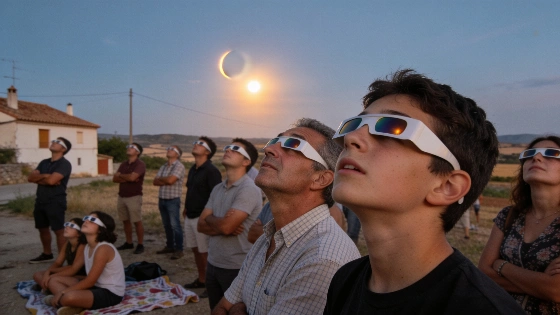
After years of preparation, Spanish astronomers and science communicators experienced a rare total solar eclipse. The event brought exhaustion, joy, and a sense of accomplishment as communities gathered across the country.
Spain’s scientific community is still processing the impact of the total solar eclipse that swept across the country. For many astronomers, the event was not only a culmination of years of anticipation but also a rare chance to share their passion with family and neighbors. In small villages and observatories, the eclipse became a social phenomenon, drawing both seasoned experts and curious locals into a shared moment of awe.
In Villaverde del Ducado, a tiny village in Guadalajara, retired astrophysics professor Jaime Zamorano and his long-time colleague Jesús Gallego hosted a star party that unexpectedly attracted over a hundred visitors. Despite limited resources, the event ran smoothly, with both professionals and families witnessing the spectacle together. Gallego noted that the low position of the sun gave the solar corona a warmer hue, making this eclipse stand out even among the six he and Zamorano have observed together.
At the Observatorio de Yebes, Eva Villaver, deputy director of the Instituto Astrofísico de Canarias, described the experience as one of the most rewarding of her career. She emphasized the unique value of seeing months of public outreach translate into genuine emotion among attendees, some moved to tears by the sight. For Villaver, the true highlight was watching millions look skyward, united by a phenomenon that felt almost otherworldly.
Elsewhere in the Señorío de Molina-Alto Tajo region, local astronomers like Javier Alcolea in Clares and Pedro García-Lario in Turmiel led their own communities through the event. Alcolea, despite a last-minute family emergency, managed to coordinate safety measures and ensure everyone, including those with limited mobility, had a clear view. After the eclipse, the village celebrated with a communal meal and an evening of stargazing, reinforcing the sense of community forged by the event.
In León, science communicator José Vicente Casado organized an ascent to La Camperona, a mountain known for its challenging climb and panoramic views. Around 600 people, half of them foreign visitors, made the trek, many independently calculating the best vantage point. Casado described the gathering as a sociological experiment, noting the absence of litter, noise, or incidents—a testament to the dedication of those who made the journey. The shared astonishment at the moment of totality, he said, bridged skepticism and wonder.
At the Observatorio Astrofísico de Javalambre in Arcos de Salinas (Teruel), Greek astrophysicist Stylianos Pyrzas experienced his first total solar eclipse. The event left him both exhausted and fulfilled after two years of preparation and public education. Pyrzas highlighted the emotional intensity of the moment and the challenge of fully processing what had happened. The observatory also hosted international guests, including a Nobel laureate and former Queen guitarist Brian May, underscoring the eclipse’s broad appeal.
In Galicia, Borja Tosar finally saw the total eclipse he had been waiting for since 1995, when he first calculated its date for his hometown of Sarria. Despite threatening clouds, he and his partner drove to Guitiriz, joining fellow astronomers and friends for the event. Tosar, who spent the past year giving talks across Galicia, was still surprised by the unique colors and atmosphere compared to previous eclipses he had witnessed abroad.
While the eclipse united communities across Spain, it also highlighted the country’s growing interest in astronomy and science outreach. The event’s success was due in part to months of preparation and clear communication about safety and viewing conditions. As with other recent events that have drawn unexpected crowds and required careful coordination—such as the surge of young Moroccans attempting risky crossings at Ceuta, detailed in this report—the eclipse demonstrated the importance of planning and public engagement in managing large gatherings.
Spain’s next total solar eclipse is not expected for several decades, making this year’s event especially significant for those who witnessed it. The experience has left many astronomers and enthusiasts eager for future opportunities, while also reinforcing the value of science communication and community involvement in bringing extraordinary moments to the public.