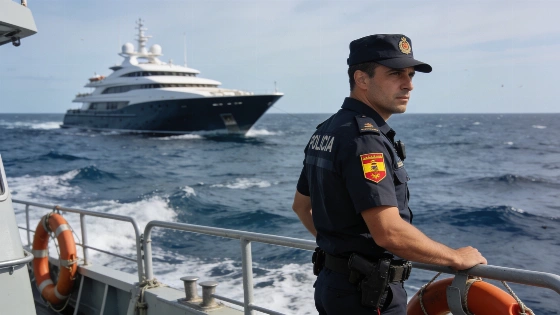
Spain’s anti-drug prosecutors have begun charging maritime traffickers with piracy after a fatal police operation. The move follows a Supreme Court decision and aims to toughen penalties for attacks on law enforcement at sea.
Spain’s fight against maritime drug trafficking has entered a new phase after prosecutors secured a historic piracy conviction against a narcotics smuggler whose actions led to the death of a customs officer. The case marks the first time Spanish authorities have applied piracy charges to drug traffickers operating in international waters, following a Supreme Court ruling that sets a precedent for future prosecutions.
The turning point came after the death of Carlos Esquembri, a 58-year-old officer from the Servicio de Vigilancia Aduanera, during a high-risk operation in March 2023. Esquembri and his team attempted to board the Rothmans, a 25-meter Maltese-flagged yacht suspected of carrying drugs, more than a thousand kilometers west of the Canary Islands. In a sudden maneuver, the yacht rammed the police launch, capsizing it and throwing all seven officers into the Atlantic. While six managed to escape, Esquembri was trapped and lost his life.
The incident highlighted the escalating dangers faced by Spanish law enforcement in open-sea drug chases. Prosecutors responded by charging the yacht’s captain not only with drug offenses, homicide, and arson—after traffickers set the vessel ablaze to destroy evidence—but also with piracy under article 616 ter of the Penal Code. This article, introduced in 2010, allows for prison terms of 10 to 15 years for violent or deceptive attacks on ships or their crews, regardless of personal gain.
Initially, the National Court convicted the defendant on all counts except piracy. However, on appeal, the court added a decade to the sentence, raising it from 27 to 37 years. The Supreme Court later upheld this decision, confirming that Spain’s definition of piracy is broader than the classic international standard and is designed to protect maritime safety from any violent threat, not just those with private motives.
The new legal approach comes amid a surge in violent confrontations at sea. In February 2024, two Guardia Civil officers died in Barbate after their patrol boat was rammed by a narcolancha during a pursuit. Similar tragedies have occurred elsewhere, including Huelva, where officers have faced armed resistance and deadly collisions. These incidents underscore the risks as police increasingly intercept drug shipments before traffickers can transfer cargo to high-speed boats—a tactic that complicates enforcement and raises the stakes for all involved.
Following the Supreme Court’s decision, anti-drug prosecutors have instructed the Guardia Civil and National Police to meticulously document attacks by narcolanchas, enabling future piracy charges. Police unions and associations, including the Asociación Unificada de Guardias Civiles (AUGC), Justicia Guardia Civil (JUCIL), and Sindicato Unificado de Policía (SUP), have welcomed the move, emphasizing the need for stronger legal tools and better protection for officers on the front lines.
While the ruling opens the door to broader use of piracy charges, questions remain about its application in Spanish territorial waters. Courts will need to clarify whether article 616 ter can be used domestically or is limited to international incidents. The practical impact will depend on how future cases are prosecuted and adjudicated.
Spain’s maritime drug routes, especially those connecting North Africa and the Iberian Peninsula, have long been a focus for law enforcement. The use of fast boats and increasingly aggressive tactics by traffickers has led to a rise in violent encounters. As noted in a related case, officers in Huelva recently faced gunfire during a pursuit, resulting in multiple arrests and large drug seizures. These developments reflect a broader trend of escalating risks and the need for robust legal responses.
Spain’s adoption of piracy charges against drug traffickers signals a shift in judicial strategy, aiming to deter violent resistance and reinforce the safety of law enforcement at sea. The coming years will show how this legal tool shapes the ongoing battle against maritime narcotics crime.